 EN-US
EN-US  ZH
ZH 
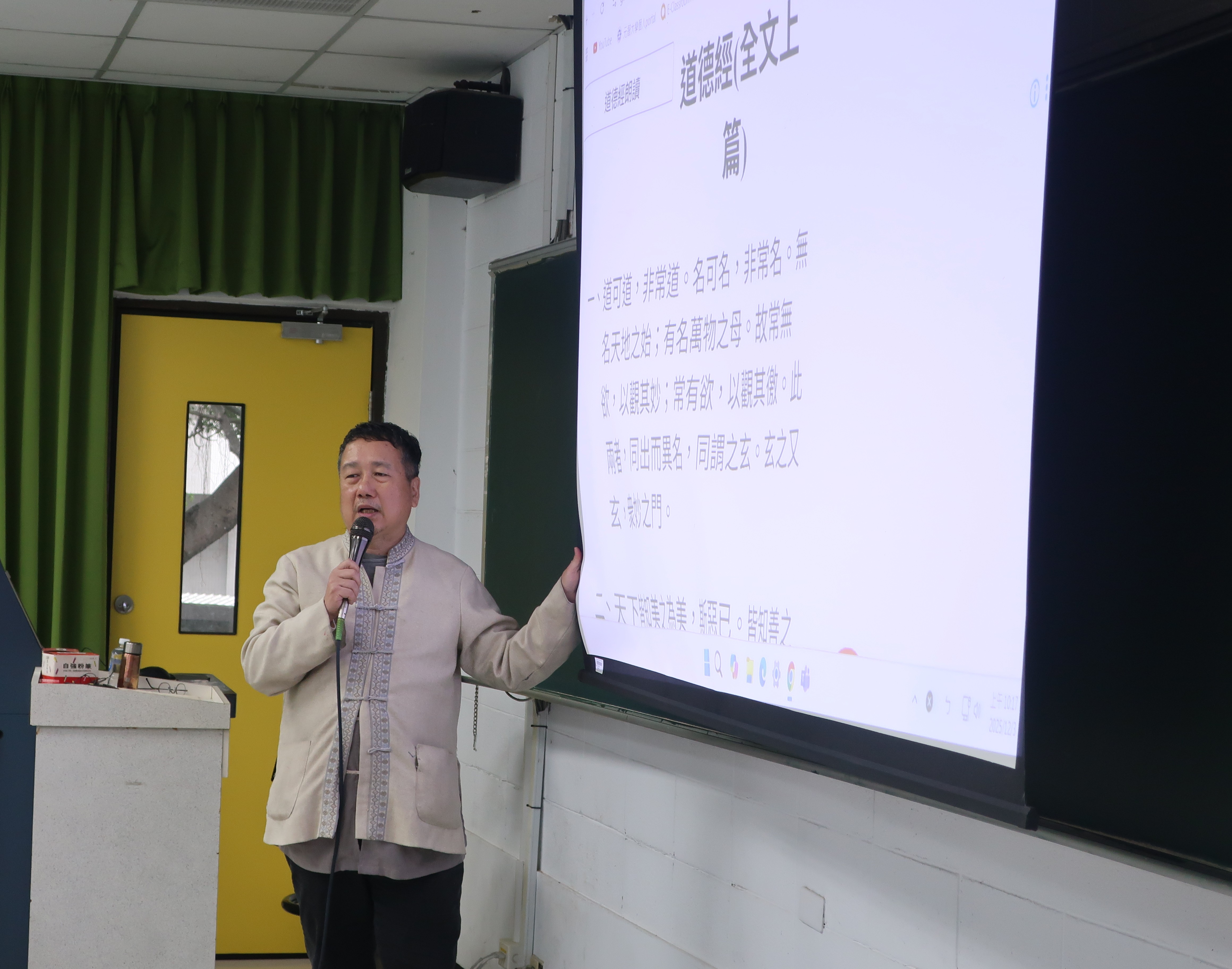
To guide young people in reflecting on the nature of life and their sense of self, the General Education Center invited Professor Xianzong Lai of the Department of Chinese Literature at National Taipei University to deliver a lecture titled “Taoist Life Wisdom: Bringing Students a New Perspective on Life.” Through classical texts, he led students to explore how to face suffering and change in everyday life. The venue was filled, and students expressed that they had gained greatly from the experience.
Professor Lai began with the opening lines of the Tao Te Ching—“The Tao that can be spoken is not the eternal Tao; the name that can be named is not the eternal name.” He pointed out that in the process of understanding and naming the world, people often become trapped in suffering because of attachment and value judgments. Using everyday examples and the allegory of the “Fruit of Knowledge” from the Garden of Eden, he humorously illustrated how distinctions of like and dislike frequently become the source of emotional fluctuation and inner distress.
When discussing the core Taoist concept of “mutual generation through opposites,” Professor Lai emphasized that life is characterized by constant change, in which birth and death, gain and loss, exist in cyclical interdependence. Citing the story of “The Old Man at the Frontier Loses His Horse,” and drawing on examples from tai chi, calligraphy, and yoga, he explained how all things operate through spiral movement and balance. He encouraged students to transcend a single-point perspective and cultivate a more multidimensional and holistic way of observation.
In the latter part of the lecture, Professor Lai further integrated the thought of Zhuangzi with ideas from Buddhist meditation, guiding students to practice the principle of “remaining without desire to perceive the subtle.” He personally led a “hua-tou” contemplation exercise, asking students to place a hand over their hearts and repeatedly question, “Who am I?” Through awareness of the arising and passing of thoughts, participants were able to allow their minds to settle and touch upon the inherent clarity of life momentarily.
To help students understand the difference between wisdom and ability, Professor Lai employed a business analogy: professional skills are like departmental divisions of labor, whereas true life wisdom is akin to a “general manager” or “chairperson” who can integrate the whole from a higher vantage point. He encouraged students not only to accumulate specialized knowledge but also to cultivate their inner selves and take command of the direction of their own lives.
At the conclusion of the lecture, Professor Lai closed the event with the musical piece “The Form of Great Virtue”, bringing the program to a perfect close. The event not only conveyed philosophical insights but also enabled students to re-examine themselves and the world, gaining renewed strength to face life's challenges.