 EN-US
EN-US  ZH
ZH 
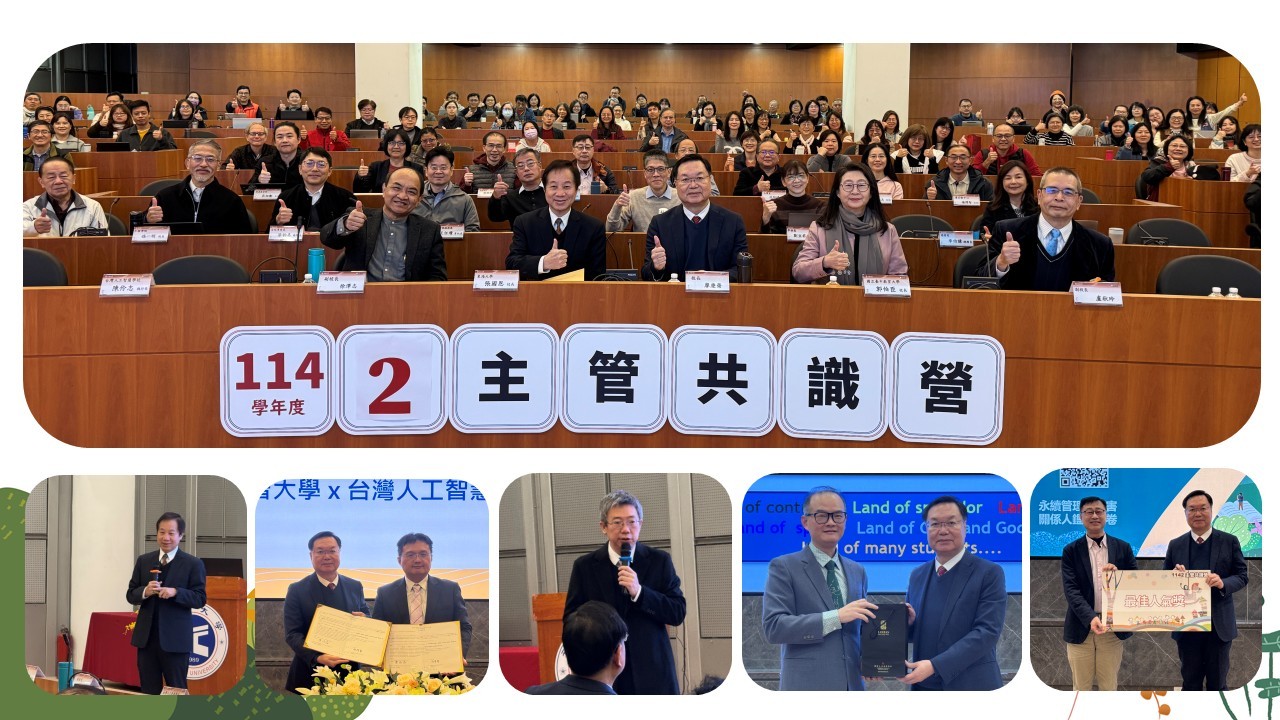
In response to the structural challenges posed by declining birth rates, intensifying competition in higher education, and the rapid development of artificial intelligence, Yuan Ze University held its “Second Leadership Consensus Camp for the 2025 Academic Year” on January 13.
Under the theme “A Resilient University under the Challenge of Declining Birth Rates—AI, Sustainability, and Internationalization,” the event brought together first- and second-level university administrators along with external leaders from higher education. Through ten thematic presentations and in-depth discussions, participants worked to build consensus on university governance and outline Yuan Ze University’s future development blueprint.
The event opened with remarks by President Ching-Jung Liao, who emphasized that universities must respond to environmental changes with a long-term perspective. He noted that only by comprehensively rethinking transformation strategies across governance, teaching, and research could universities maintain educational quality and social impact amid uncertainty.
The morning session began with a keynote address by Kuo-En Chang, President of Tunghai University, titled “The University of the Future: From AI to Sustainability.” He analyzed the profound impact of generative AI on higher education, pointing out that AI was not merely transforming teaching tools but was also reshaping learning models, faculty-student roles, and talent cultivation goals. He stressed that future universities must simultaneously address technological innovation and sustainability responsibilities, cultivating well-rounded talents equipped with AI literacy, interdisciplinary competencies, and social responsibility to remain resilient in global higher education competition.
This was followed by a presentation from Chien-Hsing Hsieh, Dean of Academic Affairs at Yuan Ze University, titled “The Three-Phase Development of AI at Yuan Ze University: Governance, Talent Cultivation, and Forward-Looking Strategies.” He systematically outlined Yuan Ze’s comprehensive strategy for advancing toward an AI-driven university, starting from university-level governance structures and institutional design. The strategy progressively implemented AI across teaching, research, and administration, while fostering forward-looking AI talent through curriculum restructuring, faculty and student development, and interdisciplinary integration—demonstrating concrete actions taken by Yuan Ze University to address higher education challenges through AI.
The third presentation was delivered by Po-Chen Kuo, President of National Taichung University of Education, under the theme “Integrating AI into Teaching and Research: Case Studies from NTCU.” He shared practical experiences of introducing AI into educational settings, emphasizing that the key lay not in the technology itself, but in its application within teaching practice. By strengthening learning analytics, personalized learning, and educational equity, and through systematic institutional support, universities could enhance AI application capabilities among faculty and students and build a human-centered smart education ecosystem.
In the latter part of the morning session, Yun Chen, Dean of the College of Medicine and Nursing, presented “Responding to Changing Times through Health Resilience: Sustainable Governance and Social Value Innovation in the College of Medicine and Nursing.” She explained how the college centered on “health resilience,” integrating AI and data analytics across talent cultivation, community engagement, and interdisciplinary research and development. These efforts addressed the needs of an aging society and public health challenges, highlighting the university’s critical role in social responsibility and sustainable governance.
The afternoon session continued the focus on AI and interdisciplinary integration. Chun-Hao Lee, Dean of the College of Humanities and Social Sciences, spoke on “When AI Becomes Part of Daily Life: A Shared Transformation of Humanities and Social Sciences Education.” He emphasized that humanities and social sciences education had become even more vital in the AI era. The college had promoted modularized curricula and AI integration, strengthening the combination of language, culture, policy analysis, and digital applications to cultivate professionals capable of working alongside AI rather than being replaced by it, thereby responding to diverse societal and industrial needs.
Next, Min-Ping Huang, Dean of the College of Management, shared insights in “The Path toward an International Professional College of Management.” She highlighted the college’s achievements in internationalization through EMI bilingual instruction, AACSB international accreditation, international mobility programs, and dual-degree partnerships. By integrating AI into recruitment, teaching, and international collaboration, the College of Management had continued to enhance its global competitiveness and international visibility.
At the level of smart teaching and governance, Rong-Bin Lin, Dean of the College of Informatics, presented “AI-Driven Smart Teaching and Governance.” He introduced applications such as smart teaching platforms, learning analytics, and AI teaching assistants, emphasizing that AI could help faculty reduce administrative burdens and improve teaching effectiveness. He also proposed establishing a university-level AI task force to systematically promote AI-driven educational innovation.
Wei-Sheng Liu, Vice Dean of the College of Electrical Engineering and Communication, approached the topic from “From Teaching to Governance: Development Strategies of the College under AI-Driven Transformation.” He proposed embedding “Agentic AI” into admissions, teaching, and administrative processes, using intelligent agent systems to enhance organizational efficiency and student support. His presentation demonstrated that AI was not only a tool, but also a key partner in university governance.
The final presentation was delivered by Yi-Ming Sun, Dean of the College of Engineering, titled “A Borderless University: Internationalization Achievements of the College of Engineering.” He shared the college’s substantial achievements in international programs, industry-academia collaboration, international internships, and dual-degree initiatives. By attracting international students and encouraging local students to study abroad, the college had created an international learning environment where “international students could come in, and local students could go out,” opening new pathways for talent cultivation in the era of declining birth rates.
The Leadership Consensus Camp concluded successfully with a comprehensive panel discussion and exchange. Through diverse perspectives shared across the ten presentations, Yuan Ze University once again reached a shared understanding: only by leveraging AI as a driving force, placing sustainability at its core, and embracing internationalization as its vision—while continuously promoting interdisciplinary integration and institutional innovation—could the university build a resilient, distinctive, and impactful future amid demographic challenges and global change.