 EN-US
EN-US  ZH
ZH 
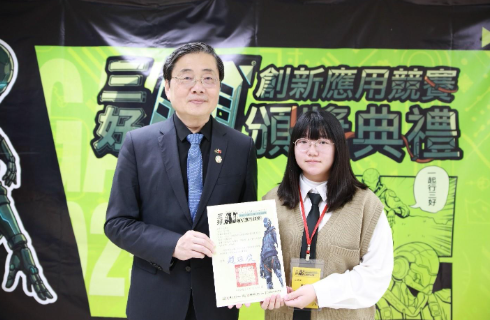
The Department of Computer Science and Engineering at Yuan Ze University delivered an outstanding performance at the San-Hao AI Innovation Application Competition, with two student teams receiving Honorable Mention awards. The achievement demonstrated the students’ excellence in innovative AI applications, interdisciplinary integration, and practice-oriented learning.
The award-winning projects were “Childhood in Words—iPABan: A Loving Interactive Reading Companion Robot for Children” and “Majilidi Team—An All-Weather Traffic Sign Recognition System Based on Edge Computing,” both of which showcased the diverse possibilities of applying AI technology to address social needs and solve real-world problems.
The project “Childhood in Words—iPABan: A Loving Interactive Reading Companion Robot for Children” was developed by Department of Computer Science and Engineering students Yu-Ru Chen, Chih-Ying Lü, Li-Chen Wang, Yu-Hsuan Li, and Meng-Chun Chen. Centered on children’s learning and companionship needs, the team integrated artificial intelligence with interactive system design to create an intelligent reading companion robot capable of accompanying young children in reading, learning, and exploration. Through interactive guidance and gentle feedback mechanisms, the system enhanced children’s focus and engagement in the learning process, with the aim of making technology not merely a tool but a warm companion in a child’s growth journey.
The other award-winning project, “Majilidi Team—An All-Weather Traffic Sign Recognition System Based on Edge Computing,” was created by students Jun-Hsien Shen and Che-Chi Li of the Department of Computer Science and Engineering. Focusing on smart transportation and public safety, the team applied edge computing and AI-based image recognition technologies to build a traffic sign recognition system capable of stable operation under various weather conditions. The system not only improved real-time recognition efficiency but also significantly reduced reliance on cloud computing, demonstrating the feasibility and value of deploying AI technologies in real-world environments.
According to the organizers, the San-Hao AI Innovation Application Competition was guided by the core principle of “technology for good.” It encouraged students to apply AI technologies to fields such as education, transportation, daily life, and social care, while emphasizing creativity, technical implementation, and social impact. During the competition, participating teams were required to present their results in video format, comprehensively evaluating their problem analysis skills, system integration capabilities, and presentation competence.
The award-winning students stated that being recognized among many outstanding entries was the greatest affirmation of their long-term dedication and repeated efforts. From concept development to implementation, continuous revisions and discussions helped the teams better understand how AI technologies should align with real needs, and further clarified their direction for continued engagement in intelligent application research. The students also expressed their gratitude to their instructors for their patient guidance and support throughout the research and implementation process, which enabled them to grow through challenges.