 EN-US
EN-US  ZH
ZH 
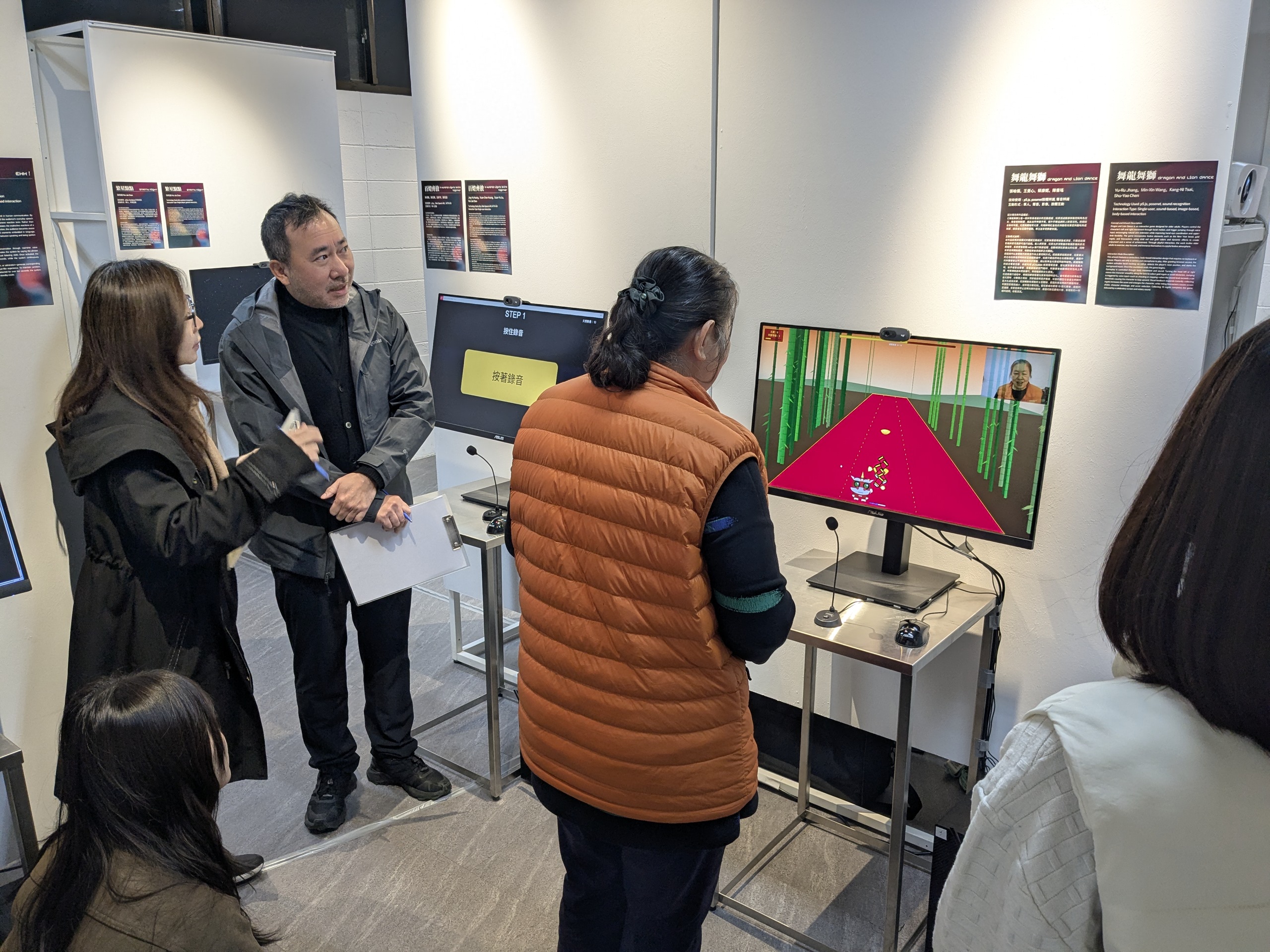
Hosted by the Arts Center of Yuan Ze University and co-curated by Professor Chu-Ching Lin of the Department of Art and Design together with students from the junior-level Design Studio course, the exhibition “Dual-Tone” was presented at the university’s Arts Center (Building 3, 1st Floor, Room 3106) and ran through February 26, 2026.
Under the theme “Two Generations, One Interface—Two Speeds, One Warmth,” the exhibition used AI interactive design as a medium for cross-generational communication, showcasing the intersection of technology and experience, of speed and slowness. Visitors were invited to enter the exhibition space and personally experience the creative energy generated through AI and intergenerational co-creation.
Professor Chu-Ching Lin of the Department of Art and Design explained that the term “Dual-Tone” not only echoed the concept of dual-band wireless transmission, but also symbolized differences in life rhythm and perceptual speed across generations. Through design, the exhibition sought to find a shared frequency of resonance. The exhibition presented a total of ten AI interactive works, two of which were created by “intergenerational co-creation” teams formed by third-year students and learners from Yuan Ze University’s Senior University, while the remaining works were individual student creations. The pieces primarily featured image-based interaction, integrating facial, body, gesture, and voice recognition, and incorporating physical installations to explore diverse possibilities for hybrid virtual–physical interaction.
Professor Lin noted that the course projects were developed on the p5.js platform using Vibe Coding, with particular emphasis on UI/UX design and age-friendly interactive experiences. Faculty and students conducted three rounds of field testing in real long-term care settings, collecting feedback to refine the work. As a result, the projects had already been validated in practical usage scenarios before the exhibition, demonstrating how design could respond to social needs in practice.
One of the representative intergenerational works, “Dragon and Lion Dance,” was co-created by Senior University learner Li-Na Chou and third-year Department of Art and Design students Yu-Ru Chang, Min-Hsin Wang, Kang-Ni Tsai, and Shu-Yao Chen. Centered on contactless motion-sensing interaction, the work allowed players to control character direction through left–right facial movements and to trigger jumps with their voices, requiring neither keyboard nor mouse. Incorporating festive elements such as the Nian beast, gold ingots, and firecrackers, along with vivid red-and-gold colors and real-time dynamic feedback, the game encouraged older adults to naturally extend their arms, improve hand–eye coordination, and enhance upper-limb flexibility—combining physical activity with enjoyment and a sense of achievement.
Another intergenerational work, “A Hundred Lanterns in Bloom,” was co-created by Senior University learner Yung-Yi Li and third-year students Jing-Ya Huang, Guan-Zhen Huang, Hsuan-Yu Lü, and Pei-Chieh Chen. Replacing traditional written wishes with spoken ones, the work invited participants to press the screen and record their wishes. The system instantly converted speech into text and combined it with a selfie to generate a pink heart-shaped sky lantern. At the same time, AI, adopting the persona of “a warm family member,” responded to the wish, completing a ritualized experience of “being heard, being responded to, and being sent skyward.” Through the integration of voice, imagery, and generative responses, technology became a gentle echo of companionship and understanding.
The curatorial team stated that “Dual-Tone” not only showcased the creative outcomes of AI interactive technologies but also explored how design could serve as an interface for communication across generations: generating the same warmth at different speeds, and transforming technology from a mere tool into a connection imbued with humanistic care and social meaning. The public was invited to visit the exhibition and experience firsthand the design energy manifested through intergenerational co-creation.