 EN-US
EN-US  ZH
ZH 
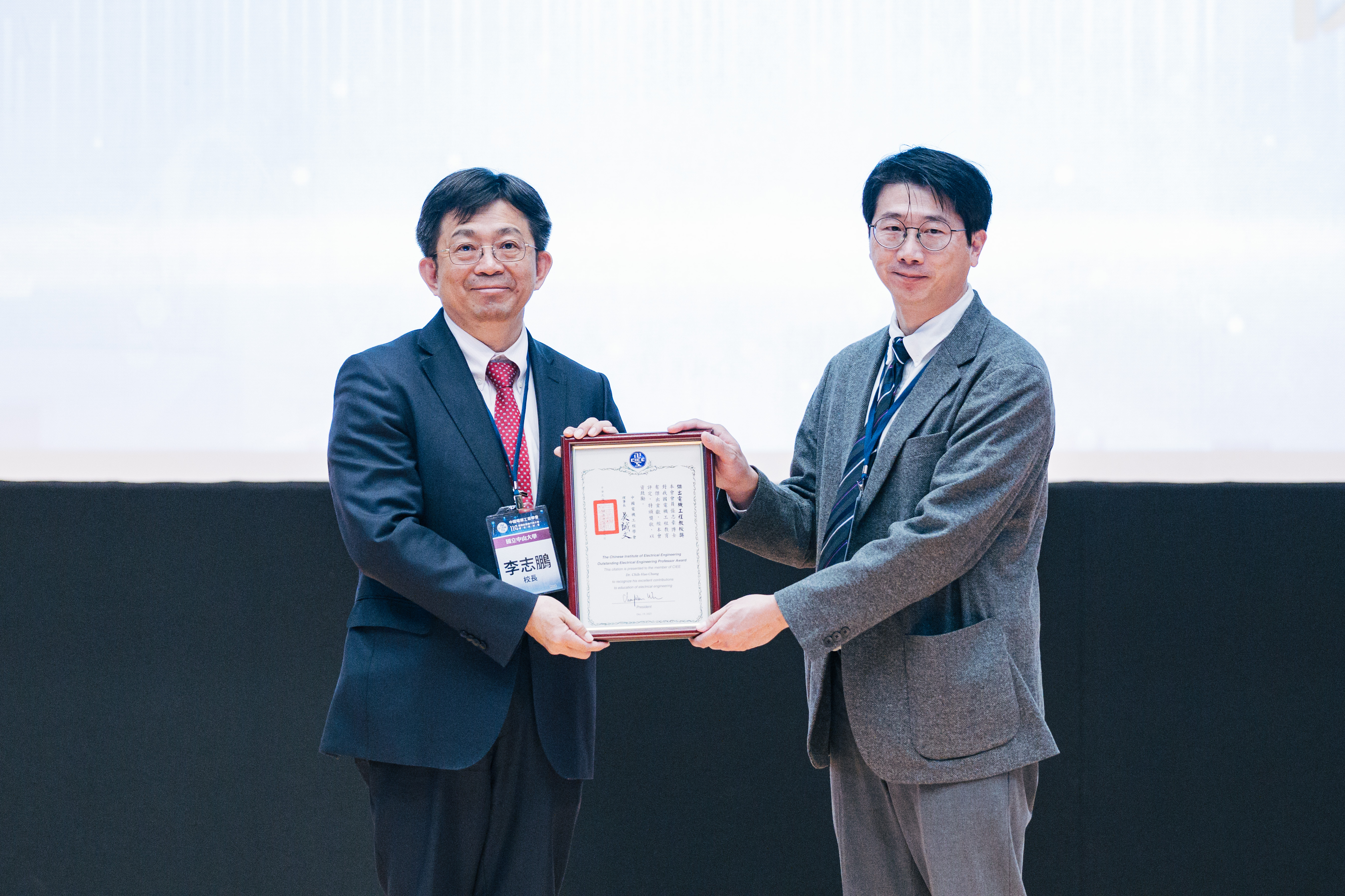
Chih-Hao Chang, Distinguished Professor in the Department of Electrical Engineering at Yuan Ze University, was honored with the 114th Outstanding Electrical Engineering Professor Award from the Chinese Institute of Electrical Engineering (CIEE). He had long devoted his work to the design of organic light-emitting devices (OLEDs), the exploration of physical mechanisms, and the development of novel materials.
His research achievements successfully extended to critical applications such as display technologies, lighting, and biomedical light sources. Meanwhile, Yi-Huai Hsu, Professor in the Department of Computer Science and Engineering, also received the Outstanding Young Electrical Engineer Award. They were the only two professors from private universities to be recognized this year, demonstrating Yuan Ze University’s excellence and strong academic impact in the fields of electrical engineering, photonics, and information engineering.
The Outstanding Electrical Engineering Professor Award presented by the Chinese Institute of Electrical Engineering was considered a highly prestigious academic honor within Taiwan’s electrical engineering and information technology fields. Evaluation criteria included research achievements, teaching performance, academic service, academic influence, international visibility, and contributions to industry and society, making the award highly respected among the academic community.
Professor Chih-Hao Chang’s research expertise covered OLED design, flexible light-emitting devices, and emerging optoelectronic material development. He had continuously committed himself to overcoming technical bottlenecks in OLED efficiency, stability, and application. His research repeatedly set international records and drew significant attention from the global research community. As of now, he has published more than 130 SCI journal papers, receiving over 5,900 citations, with an h-index of 41. His works had been featured in top-tier journals such as Advanced Materials, Advanced Functional Materials, Angewandte Chemie International Edition, Chemical Engineering Journal, and ACS Applied Materials & Interfaces, and many were selected as journal covers or thematic features.
Beyond his outstanding academic achievements, Professor Chih-Hao Chang also earned numerous major recognitions, including the Yushan Chair Professor Award, Yushan Distinguished Professor Award, Far Eastern Outstanding Spirit Award, the International Distinguished Inventor Award, and the Academic Kuo-Kuang Medal. He had also been elected Fellow of the International Advanced Materials Association, reflecting his high level of impact in the global academic community.
Regarding research applications and collaboration, Professor Chang actively promoted cross-border and interdisciplinary research. He established long-term collaborations with research teams in France, Lithuania, Latvia, Ukraine, India, Germany, Spain, and Hong Kong. He led multiple National Science and Technology Council–funded projects, international research programs, and industry-academia collaborations, driving the transformation of fundamental research into real-world applications and industrial value.
In medical applications, he collaborated with medical teams at Far Eastern Memorial Hospital to develop broadband and deep red OLED phototherapy technologies, aiming to enhance tissue oxygenation, promote angiogenesis, and support wound healing. Related phototherapy devices had entered clinical trial stages, demonstrating strong clinical application potential.
In the areas of teaching and talent cultivation, Professor Chang continuously guided students to engage in academic research and participate in domestic and international competitions. His students repeatedly received Best Paper Awards and Student Paper Awards from the Chinese Institute of Engineers and international optoelectronics conferences. Many had also been funded by the National Science and Technology Council's undergraduate research programs. Graduates trained under his supervision had gone on to pursue further studies at leading universities and enter well-known technology companies, contributing significantly to Taiwan’s optoelectronics and semiconductor talent pipeline.
Regarding future development, Professor Chih-Hao Chang stated that he would continue advancing research in high-efficiency and flexible organic light-emitting devices, while strengthening development of biomedical light sources and industry–academia collaborations. He expressed the hope that through interdisciplinary integration and international cooperation, Taiwan’s research capacity and global competitiveness in advanced optoelectronics and biomedical technologies would continue to rise.