 EN-US
EN-US  ZH
ZH 
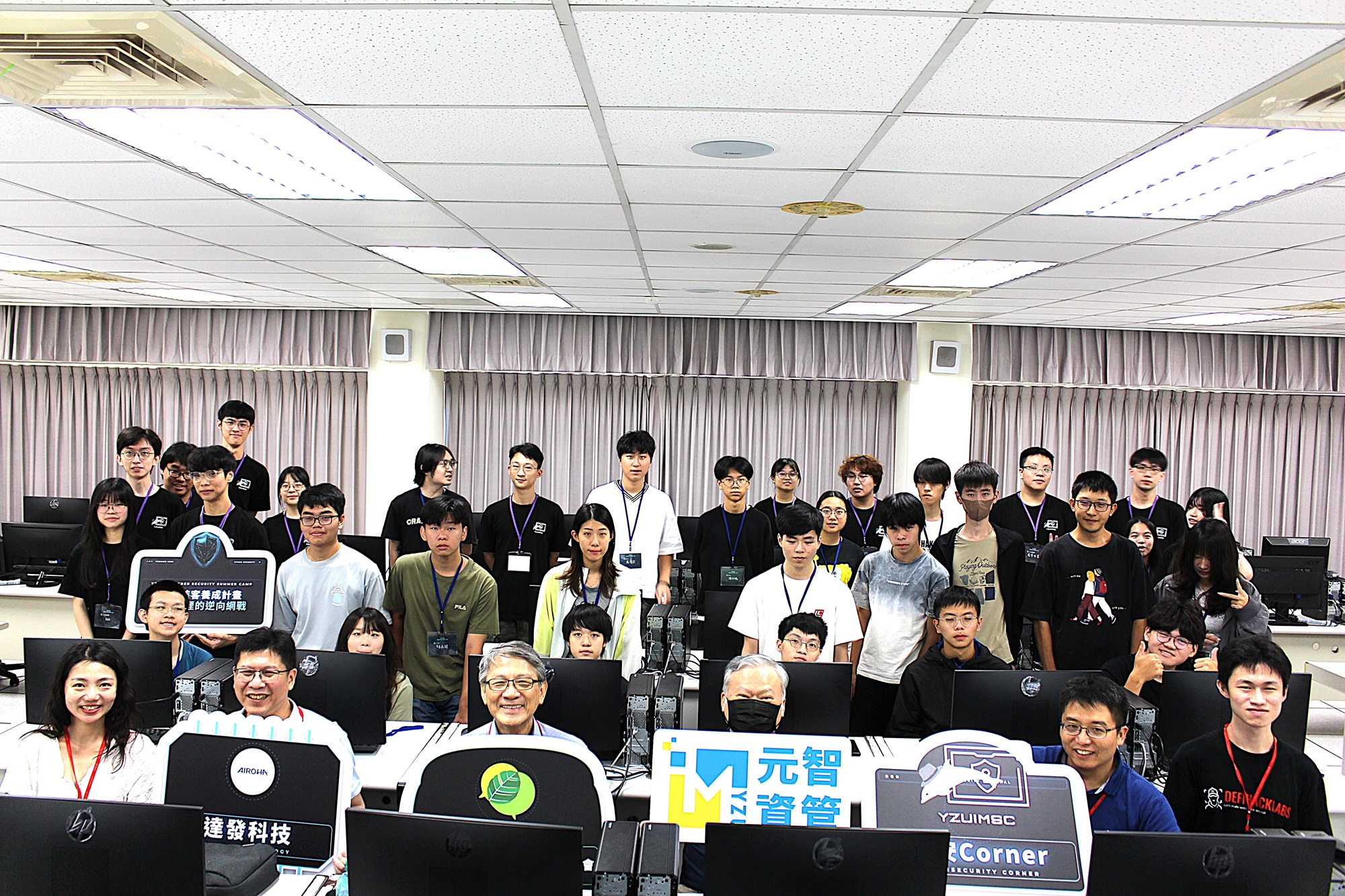
The Department of Information Management at Yuan Ze University collaborated with the Hwa-Hsia Environmental Protection and Digital Future Foundation and Airoha Technology Corp. to host the Full-Stack Hacker Development Program (YZUIMSC Cybersecurity Summer Camp 2026) on August 15 and 16. The program brought together cybersecurity experts from academia and industry to provide high school students and incoming college freshmen with hands-on training in Linux, Web Exploitation, Reverse Engineering, and Pwn vulnerability exploitation. Through a Capture the Flag (CTF) competition, participants demonstrated their learning outcomes while developing cybersecurity awareness and practical skills.
At the opening ceremony, De-Tsai Lee, Chairman of the Hwa-Hsia Environmental Protection and Digital Future Foundation, stated that the digital-native generation had become highly dependent on the internet and digital technologies. While enjoying the convenience offered by these technologies, young people had also become more vulnerable to threats such as phishing attacks, data theft, and online fraud. He emphasized that “personal data is an asset” and stressed the importance of developing strong awareness of data protection and risk management. He further noted that learning cybersecurity techniques required adherence to ethical and legal boundaries, and that the white-hat hacker spirit should be upheld to safeguard the digital environment.
Kuo-Chung Chang of the Department of Information Management at Yuan Ze University said that students should seize every opportunity to explore cybersecurity technologies, whether they possessed a strong interest in the field or were simply driven by curiosity. He encouraged participants to ask questions boldly and actively solve problems, cultivating resilience and a positive learning attitude through hands-on practice while laying a solid foundation for future studies in cybersecurity.
The camp featured a distinguished lineup of instructors. “Goat,” who had won second place in the Central Taiwan Cybersecurity Skills Competition 2026 and received the AIS3 Best Project Award, taught Linux fundamentals. “Ching,” who had achieved first place in Taiwan at the HITCON CTF 2026 Exchange Competition, introduced Web Exploitation techniques. “CX330,” a speaker at CraftCon 2026 and recipient of the AIS3 Junior Best Teaching Assistant Award, instructed participants in Reverse Engineering. In addition, “owl_d,” former chief coordinator of the HITCON Village B33F50up booth and a penetration testing instructor for the Ministry of Economic Affairs AI Talent Program, taught Pwn vulnerability exploitation. Together, they guided participants from foundational knowledge to practical cybersecurity attack-and-defense exercises.
Manager Wu, Cybersecurity Director at Airoha Technology, shared the company’s cybersecurity philosophy and practical experience. He reminded participants that cybersecurity risks had extended beyond computers and smartphones to a wide range of digital devices. Even internet-connected devices such as wireless earphones could become potential sources of information leakage. As artificial intelligence continued to advance rapidly and global cybersecurity requirements continued to increase, the demand for cybersecurity professionals was expected to grow steadily in the future.
Airoha Technology also encouraged participants to uphold cybersecurity ethics, noting that hacker skills were similar to martial arts. In addition to refining technical capabilities, cybersecurity practitioners were expected to comply with legal and ethical standards and apply their expertise to defense and protection while embracing the white-hat hacker spirit.
On the second day of the camp, participants competed in the CTF competition, applying what they had learned to identify vulnerabilities, analyze problems, and complete challenges. The competition enabled them to transform knowledge into action. The organizers stated that they hoped to continue strengthening cybersecurity education through industry-academia collaboration, encouraging young students to develop their interests, gradually build practical capabilities and cybersecurity ethics, and become a new generation of white-hat hackers equipped with both technical expertise and a strong sense of responsibility to help safeguard Taiwan’s digital environment.