 EN-US
EN-US  ZH
ZH 
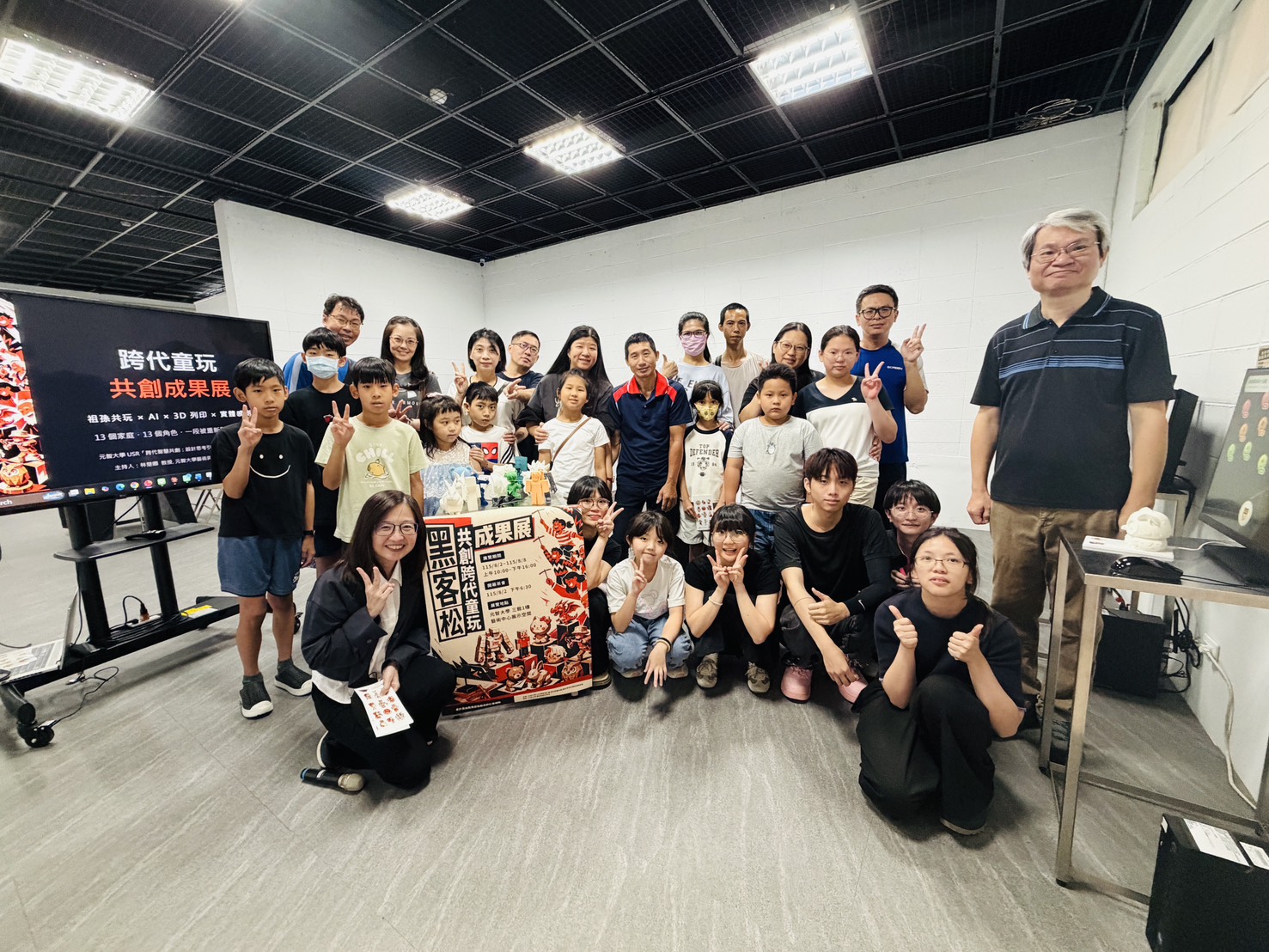
Traditional childhood toys such as bamboo dragonflies, spinning tops, paper airplanes, and the classic game “Red Light, Green Light” were reimagined through artificial intelligence (AI) and 3D printing technologies and transformed into interactive digital games. The “Intergenerational Traditional Toy Hackathon Exhibition,” organized under the University Social Responsibility (USR) project “Intergenerational Smart Co-Creation: Design Thinking for Technology and Well-Being,” was exhibited at the Arts Center exhibition space on the first floor of Yuan Ze Building 3 at Yuan Ze University from now until August 8. The exhibition was open to the public free of charge from 10:00 a.m. to 4:00 p.m. daily, inviting visitors to experience the innovative integration of technology and traditional childhood games.
The exhibition originated from the “Intergenerational Traditional Toy Hackathon” held on July 4, which brought together 13 families and students from Yuan Ze University. During the event, parents shared memories of childhood games, children contributed ideas inspired by modern gaming experiences, and university students served as facilitators. Through design thinking, AI applications, and digital fabrication technologies, the participants transformed intergenerational gaming memories into digital interactive creations.
The program covered AI creative applications, 3D printing, and interactive installation design. Chor-Kheng Lim, Professor and Director of the Department of Art and Design, College of Humanities and Social Sciences, Yuan Ze University, and principal investigator of the USR project, guided parents and children in learning how to use AI tools. Chih-Ming Huang, Lecturer of the Department of Chinese Linguistics and Literature, instructed participants on using prompts to communicate creative concepts to AI, helping children transform their imaginative game ideas into tangible creations.
During the activities, family members described traditional toy concepts to AI using natural language, and the AI instantly generated web-based interactive games. Characters designed by children were converted into 3D models and produced as customized game figurines through 3D printing. Participants also applied the emerging concept of “Vibe Coding,” describing desired interactive effects verbally, such as “triggering signals when a spinning top was rotated” or “playing sound effects when a light source was blocked.” AI then assisted in developing the sensor programming required to make the interactive devices function in practice.
Chor-Kheng Lim noted that traditional toys had carried shared memories across generations. Through AI and digital fabrication technologies, parents’ childhood experiences could be combined with children’s creativity. This approach not only preserved cultural memories but also helped more people understand that creative works could be produced through AI without a programming background, provided that ideas were communicated clearly.
The exhibition fully presented the co-created projects developed by participating families during the hackathon. Visitors could interact with the digital games, use 3D-printed figurine controllers to play classic games such as “Red Light, Green Light,” and view 3D-printed characters hand-painted by children. Exhibition visitors could also learn about the family stories behind each project through accompanying displays. The organizers stated that since the exhibition opened on August 2, it had attracted numerous families with children. Several participating families also returned during the opening reception to share their creative experiences and project outcomes.
The project “Intergenerational Smart Co-Creation: Design Thinking for Technology and Well-Being” was a seed-stage USR initiative supported by the Ministry of Education’s Higher Education Sprout Project and co-organized by the Department of Art and Design, College of Humanities and Social Sciences, Yuan Ze University. The project had long promoted design thinking, technology applications, and intergenerational co-learning while encouraging community engagement and innovative practice.