 EN-US
 ZH

The Department of Information Communication at Yuan Ze University once again earned international recognition for its students’ outstanding achievements in design. The 2026 ISARCH Awards, organized by the Spain-based ISARCH international organization, recently announced this year’s winners. YZU students stood out among more than 10,000 entries from approximately 65 countries, winning four awards: one Bronze Award and two Winner distinctions in the Digital category, as well as one Winner distinction in the Graphic Design category.
Based on its accumulated award achievements over the past five years, Yuan Ze University rose to 15th place in the ISARCH global university rankings and ranked 2nd in Taiwan, highlighting the University’s strong achievements in interdisciplinary creative education and the development of internationally competitive design talent.
Founded by the ISARCH international organization in Spain, the ISARCH Awards covered six major fields: architecture, product design, graphic design, fashion, digital design, and art. The competition was also listed by Taiwan’s Ministry of Education as a Second Tier award under the Incentive Program for Encouraging Students to Participate in International Art and Design Competitions (IDC). The ISARCH global university rankings were based on each university’s accumulated award achievements over the previous five years, reflecting sustained performance and international competitiveness in design education.
This year’s award-winning projects spanned artificial intelligence, interactive installations, psychological support, and visual arts, demonstrating the students’ ability to use technology creatively to address contemporary social issues.
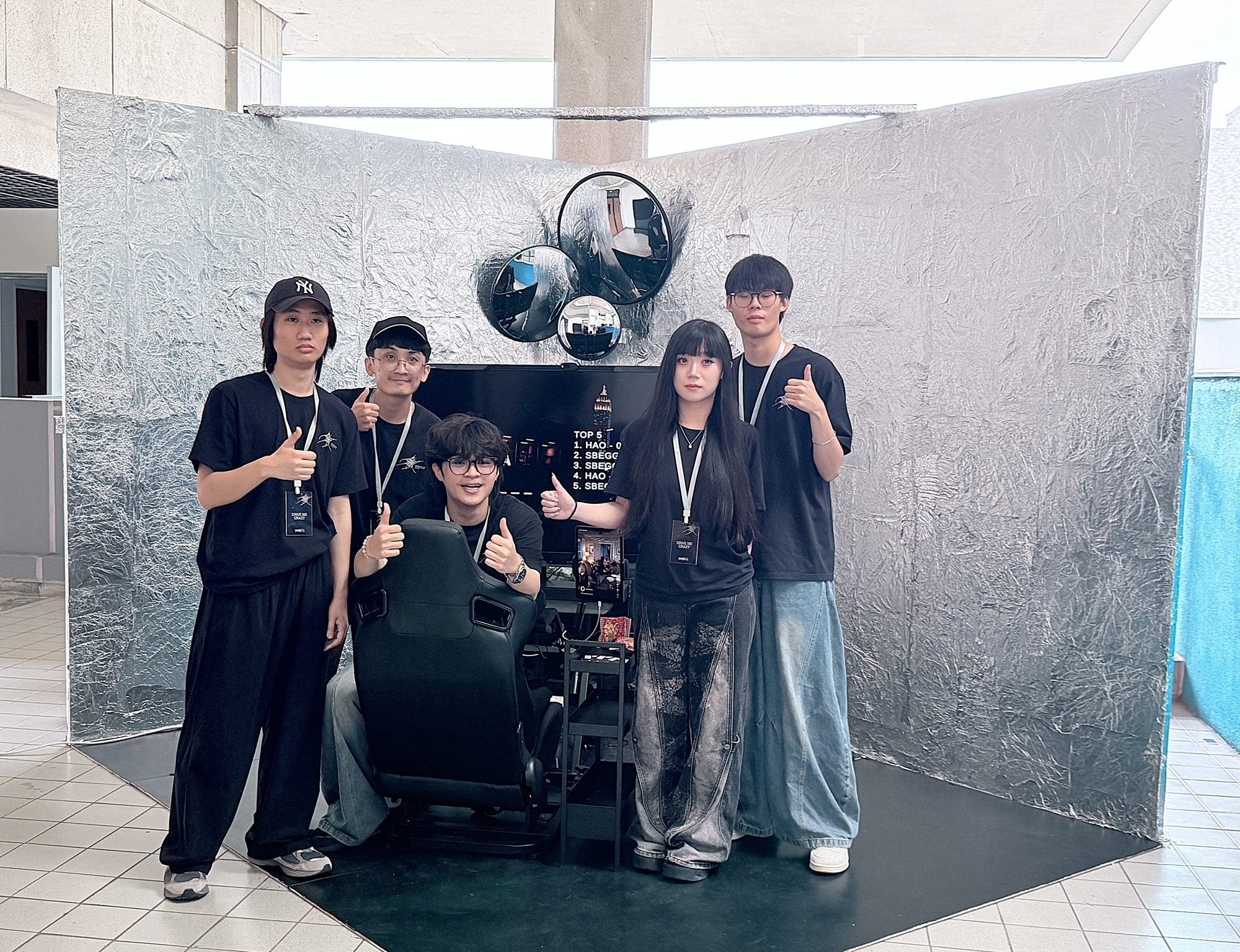
Drive Me Crazy, which received a Bronze Award in the Digital category, addressed the issue of distracted driving through a combination of AI-powered facial expression recognition and interactive gaming. The project simulated how fragmented attention in the age of short-form video could affect driving safety. By identifying players’ levels of attention in real time, the system dynamically adjusted in-game distractions and provided data analysis at the end of the experience, encouraging users to reflect on the risks of distracted driving. The project was jointly created by Sheng-Hung Hsiao, Chin-Wei Chou, Kai-Lin Huang, Cheng-Yu Kang, and Yun-Hao Tseng under the guidance of Chieh-Ju Huang and Yu-Chi Chen.
Yǐn, a Winner in the Digital category, explored how people could regain focus and balance amid digital information overload. The project combined a balance-beam installation with real-time new media visuals. Using TouchDesigner for real-time computation, the installation transformed visitors’ walking speed and movements into dynamic imagery, using visual changes to reveal the relationship between physical movement and psychological rhythm. The project was jointly created by Wei-Hsiang Lin, Chih-An Lin, Kuan-Yu Hung, Yu-Ying Chang, and Pei-Ting Tsai under the guidance of J I Chiu, Wen-Pinn Fang, and Akira Chen.
Another Digital-category Winner, NOVUS, focused on the psychological adjustment and social challenges faced by first-year university students. The team designed an app integrating anonymous interaction, emotional communication, and psychological support features. The platform aimed to lower psychological barriers to seeking counseling resources while helping first-year students build interpersonal connections and a stronger sense of belonging on campus. The project was jointly created by Hsing-Yu Chen and Chiao-Yin Chuang under the guidance of Chieh-Ju Huang and Yu-Chi Chen.
In the Graphic Design category, Yu-Chieh Tsai received a Winner distinction for Maeitic Core 0-9 under the guidance of Chieh-Ju Huang. Based on the Arabic numerals from 0 to 9, the work creatively incorporated the forms and characteristics of marine life. Through intricate lines and vibrant colors, the project reinterpreted the visual relationship between numerical symbols and the natural environment, demonstrating both artistic sophistication and creative imagination in graphic design.
Since its establishment in 1994, the Department of Information Communication at Yuan Ze University had been dedicated to integrating design, communication, and information technology, with an emphasis on interdisciplinary learning that combined aesthetic creativity, AI applications, and humanistic awareness. Through capstone projects, industry internships, and international competitions, the Department cultivated students’ innovative design capabilities and practical skills.
Looking ahead, the Department said it would continue to deepen the integration of AI and digital media and cultivate digital talent equipped with technological expertise, creative thinking, and international competitiveness.