 EN-US
EN-US  ZH
ZH 
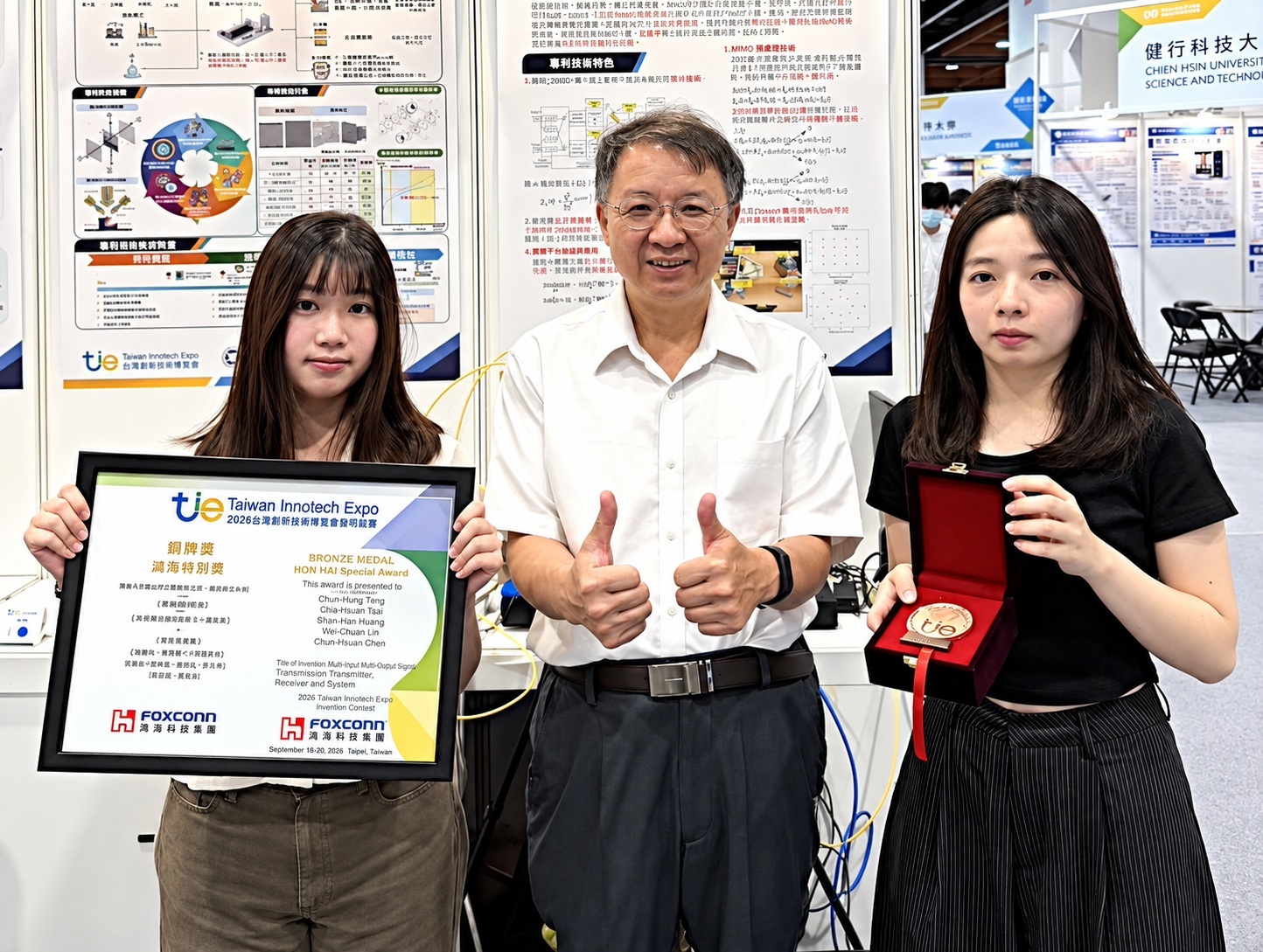
In response to the growing trend of 6G and Low Earth Orbit (LEO) satellite communications, Yuan Ze University’s advanced communications research once again received national recognition. A research team led by Professor Chun-Hung Teng of the Department of Electrical Engineering, College of Electrical and Communication Engineering, participated in the invention competition at the 2026 Taiwan Innotech Expo with its project, “Multiple-Input Multiple-Output Signal Transmission Transmitter, Receiver, and System.”
The project received a Bronze Medal and was also honored with a Foxconn Technology Group Special Award, highlighting Yuan Ze University’s research capabilities and application potential in millimeter-wave communications, Multiple-Input Multiple-Output (MIMO) technologies, and LEO satellite communication systems.
As Low Earth Orbit satellites, 6G mobile communications, and integrated satellite-terrestrial networks continued to develop rapidly, Doppler frequency shifts caused by high-speed mobility, together with interference resulting from simultaneous multi-antenna and multi-signal transmissions, became major challenges affecting communication quality. To address these issues, the Yuan Ze University research team integrated millimeter-wave active antenna arrays, a MIMO Software-Defined Radio (SDR) platform, spatial interference suppression techniques, and signal preprocessing technologies to develop an innovative solution.
Chun-Hung Teng explained that the research team established a simulation platform for LEO satellite communications. By combining dual millimeter-wave active antenna arrays with a MIMO-SDR system, the platform simulated realistic communication scenarios, including rapid Doppler effects caused by fast-moving satellites, line-of-sight transmissions, and multi-antenna signal interference. The system first estimated and compensated for rapid Doppler frequency shifts and then employed millimeter-wave antenna arrays to perform beam scanning, identifying signal transmission directions as the basis for subsequent beamforming and interference suppression.
To address interference among different signal streams in MIMO systems, the team further applied Spatial Nulling technology, which reduced interference from undesired directions while maintaining primary signal transmission. In addition, an LS-based MIMO pre-equalization mechanism was implemented to eliminate residual signal crosstalk. Together, these technologies formed a hybrid signal-processing architecture that combined spatial interference suppression and MIMO pre-cancellation.
Unlike many studies that remained limited to theoretical analysis or computer simulations, a distinctive feature of this technology was its validation through Over-the-Air (OTA) testing on a physical SDR platform. Experimental results demonstrated that the proposed technology effectively reduced interference among multiple signal streams and improved Error Vector Magnitude (EVM) performance. EVM is an important indicator of digital communication signal quality, and reduced error levels indicated improved transmission quality and system reliability.
Chun-Hung Teng noted that the research outcomes were expected to be applied to Low Earth Orbit (LEO) satellite communications, millimeter-wave MIMO systems, 6G wireless communications, smart antenna technologies, and high-bandwidth Software-Defined Radio platforms. The technology could also serve as an important foundation for future academic research, industry-academia collaboration, and practical communication system validation.
The project integrated interdisciplinary technologies ranging from millimeter-wave radio frequency circuits, active antenna arrays, digital signal processing, and MIMO communications to SDR platforms. The research extended from algorithm design to full-scale hardware platform verification. By receiving both the Bronze Medal and the Foxconn Technology Group Special Award at the 2026 Taiwan Innotech Expo, the project not only demonstrated the innovation of its research achievements but also reflected the College of Electrical and Communication Engineering’s continued commitment to advancing next-generation communication technologies, strengthening hardware-software integration, and cultivating advanced communications talent.