 EN-US
EN-US  ZH
ZH 
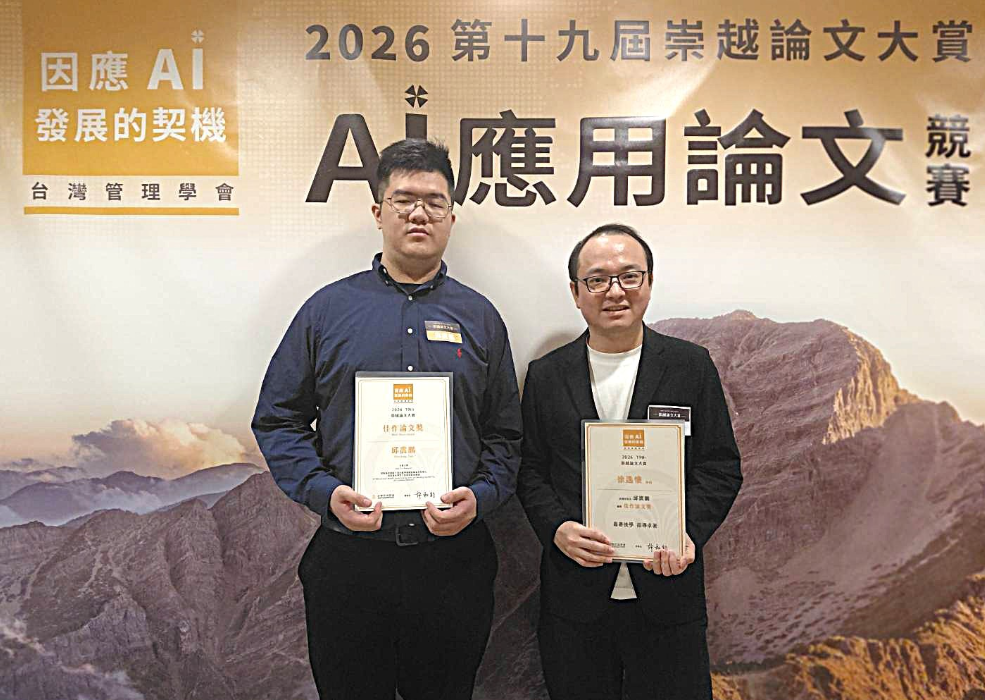
How can artificial intelligence improve the efficiency and energy conservation of low-Earth-orbit (LEO) satellite communications? Under the guidance of Professor Yi-Huai Hsu, Chen-Peng Chiu, a master's student from the Department of Computer Science and Engineering at Yuan Ze University, incorporated graph neural networks and multi-agent deep reinforcement learning into 6G LEO satellite communication research and proposed an energy-efficient routing mechanism. His work recently earned the Honorable Mention Award in the Master's Division at the 19th Excellent Thesis Award, standing out among 1,021 master's and doctoral theses and showcasing the university's achievements in interdisciplinary research integrating artificial intelligence and next-generation communications.
The Excellent Thesis Award is one of Taiwan's most prestigious thesis competitions. This year, 1,021 theses were submitted, of which 255 advanced to the final round and 193 ultimately received awards. Chen-Peng Chiu participated with his thesis, “An Energy-Efficient Routing Mechanism Based on Graph Neural Network-Assisted Multi-Agent Deep Reinforcement Learning in Low-Earth-Orbit Satellite Networks.” His research focused on addressing the challenges of energy consumption, transmission efficiency, and network stability in future 6G LEO satellite networks.
Compared with conventional terrestrial communication networks, LEO satellites move at high speeds, causing constant changes in network topology. Coupled with limited onboard power resources, identifying suitable data transmission routes in highly dynamic environments has become a critical issue in improving satellite communication performance. To address this challenge, Chen-Peng Chiu combined graph neural networks with multi-agent deep reinforcement learning, enabling artificial intelligence to comprehend complex network conditions and make routing decisions. The proposed mechanism simultaneously optimized energy efficiency, transmission latency, and network stability, offering a promising new direction for future LEO satellite communication research.
Professor Yi-Huai Hsu noted that the award not only recognized the student's research achievements but also demonstrated the research and application potential of integrating artificial intelligence with LEO satellite communications. As 6G and LEO satellite technologies continue to advance, he emphasized that using AI to address increasingly complex and rapidly changing network challenges will become an important area for further exploration. He also encouraged students to continue developing innovative and practical solutions based on real-world problems.
Chen-Peng Chiu said that the project underwent numerous rounds of refinement, from defining the research direction and designing algorithms to conducting simulation verification. Each revision provided an opportunity to reexamine the problem and identify better solutions. “I am delighted that my research has been recognized by the judges, and I am grateful to Professor Yi-Huai Hsu for his guidance and support throughout the research process,” he said. The competition experience not only validated the value of his research but also strengthened his determination to pursue further studies in artificial intelligence and next-generation networking technologies.
By connecting advanced AI algorithms with 6G LEO satellite communications, Chen-Peng Chiu's research integrated expertise in computer science with cutting-edge communication technologies. The achievement demonstrated students' ability to solve real-world networking challenges and highlighted Yuan Ze University's accomplishments in cultivating interdisciplinary talent in artificial intelligence, communication networks, and emerging technologies.