 EN-US
EN-US  ZH
ZH 
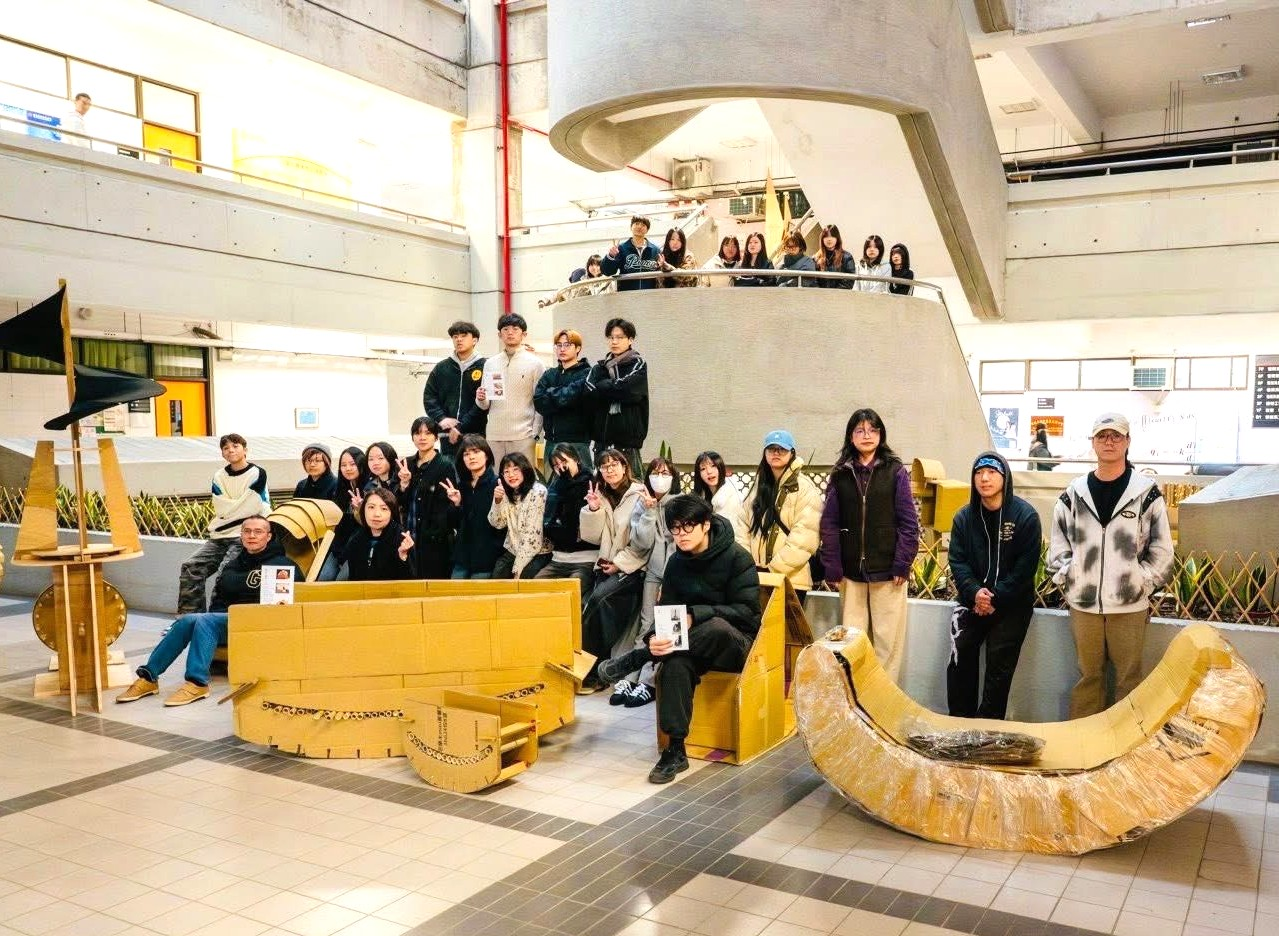
The Department of Art and Design at Yuan Ze University held the final review and critique for its sophomore design studio course, presenting a collaborative project titled “Windcatcher: A Shelter/Furniture for the Invisible Flow.” A total of 34 students participated in the course.
Through both in-person and online critique sessions, students showcased furniture and small-scale spatial installations centered on recycled materials, demonstrating the concrete integration of sustainability concepts and hands-on practice in design education.
The “Windcatcher” project guided students to begin from bodily perception and spatial experience, exploring how wind could be made visible and audible, and even transformed into a medium for shelter and pause. Students were required to use second-hand cardboard boxes as the primary material, combined with mixed media such as bamboo, wood, textiles, wiring, lighting, and sensors. Each student designed and built a piece of furniture or a small spatial installation capable of supporting their own body weight while providing comfort and a sense of security. The works were installed in semi-outdoor campus spaces to interact with wind, light, shadow, and pedestrian movement.
Instructor Wan-Wen Huang stated that the course materials were made possible through a donation of large quantities of used cardboard boxes from Momo Fubon Media Technology. This enabled students to design and construct under real material and structural constraints. With coordination support from Yuan Ze University’s Center for Sustainable Development and Social Responsibility, corporate resources, university courses, and sustainability principles were successfully connected, turning circular reuse from a classroom concept into an actionable design practice.
The Windcatcher works demonstrated diverse design approaches and sensory interpretations. Some projects transformed wind into light, shadow, and rhythm through cutting, suspension, and sensor-based interaction. Others used curved and layered structures to guide airflow and leave visible traces of movement across cardboard surfaces. Some works incorporated mechanical motion or emotional spatial expressions, turning cardboard into a medium for imagination, bodily experience, and perception. Through the transformation of recycled materials, students not only strengthened their understanding of structure and scale but also deepened their awareness of the relationships among environment, resources, and everyday aesthetics.
Yuan Ze University noted that through corporate material donations, internal sustainability coordination mechanisms, and practice-oriented design courses, students learned how to respond creatively to sustainability issues under real-world conditions. The university stated that it would continue to promote cross-department and industry collaboration, positioning design education as an important platform linking sustainable development, social responsibility, and innovative action.