 EN-US
EN-US  ZH
ZH 
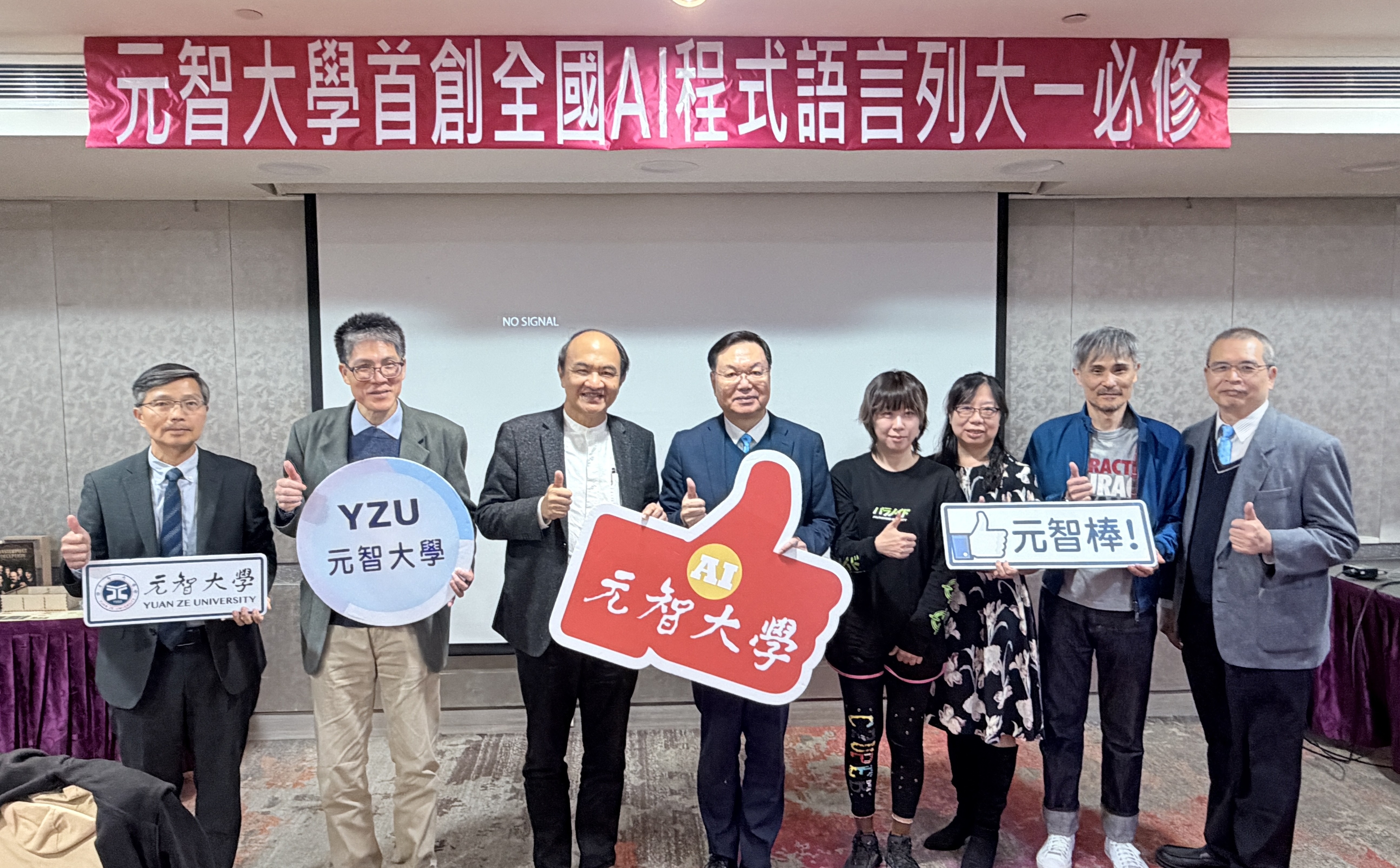
As global higher education accelerated the integration of artificial intelligence into core competencies, Yuan Ze University announced that beginning in the 2026 academic year, “AI Programming Language” would be designated as a mandatory course for all first-year students.
The University thus became the first higher education institution in Taiwan to comprehensively require AI programming for all freshmen, formally incorporating artificial intelligence into a shared foundational competency for every student. This milestone symbolized a fundamental upgrade of the university's general education from digital literacy to AI literacy.
In recent years, artificial intelligence has rapidly emerged as a key competency in higher education worldwide. Purdue University in the United States had announced that students entering in the fall would be required to demonstrate AI Working Competency prior to graduation, signaling that AI was becoming a new baseline requirement in higher education systems. By contrast, most universities in Taiwan had primarily adopted integrative approaches—such as establishing AI programs, interdisciplinary modules, competitions, or course incentives—which, while flexible, made it difficult to build a consistent competency framework for all students. Yuan Ze University’s institutionalized, mandatory adoption of AI represented a major milestone in Taiwan’s higher education, marking a shift from advocacy to structural reform.
Chien‑Hsing Hsieh, Dean of the Office of Academic Affairs, Yuan Ze University, explained that as early as 2016, the University had taken the lead in making programming a university-wide general education requirement, proposing the concept of programming and English proficiency as a “new bilingual” foundation. After nearly a decade of sustained development and the accumulation of digital education capacity, the University completed a comprehensive integration of its AI curriculum framework in 2026. Existing programming courses were fully upgraded to “AI Programming Language”, ensuring that all students established AI thinking and computational logic from their first year. In addition, students were required to complete at least three credits of AI digital application courses before graduation, enabling them to apply artificial intelligence directly within their respective disciplines.
Dean Hsieh emphasized that this framework not only ensured that all students possessed a consistent foundation in AI and human–machine collaboration skills, but also established a complete developmental progression—from understanding and application to integration—within the University’s competency structure.
To support this transformation, each academic unit established dedicated AI course modules, implementing a systematic cultivation model described as “Understanding AI, Using AI, Creating AI, and Leading AI.” At the “Understanding AI” stage, all students were required to complete the AI Programming Language course to build computational thinking and foundational AI literacy. At the “Using AI” stage, interdisciplinary applications were emphasized, with generative AI and intelligent analytics integrated into fields such as the humanities, management, and healthcare, making AI a shared learning tool across the University. At the “Creating AI” and “Leading AI” levels, programs in engineering and electrical and communication engineering further deepened model design, system development, and industry–academia collaboration, while incorporating technology ethics and advanced computing strategies. Together, these efforts formed a comprehensive talent cultivation system spanning foundational learning, innovative research and development, and governance perspectives.
In parallel, Yuan Ze University established a university-level, shared, enterprise‑grade AI computing infrastructure, significantly enhancing the high‑performance computing environment required for teaching and research. During the first year, a core computing resource pool was created, incorporating high‑density GPU servers and high‑speed interconnect technologies to strengthen multi‑GPU parallel computing performance and data transmission stability. A parallel file system specifically designed for AI workloads was also deployed, forming a petabyte‑scale high‑speed storage architecture to effectively address data throughput and I/O bottlenecks encountered in large‑scale model training. This infrastructure provided a shared AI research and development platform for faculty and students, promoting the practical application of artificial intelligence in teaching innovation, academic research, and industry–academia collaboration, while continuously reinforcing the core capacity of a smart campus.
In addition, Yuan Ze University announced that beginning in the 2026 academic year, undergraduate students were required to complete at least one interdisciplinary program, micro‑program, minor, or double major prior to graduation. This policy elevated interdisciplinary learning from an encouraged option to an institutional requirement, ensuring that every student developed the ability to integrate knowledge across disciplines.
While strengthening technology education, the University also continued to deepen its English‑Medium Instruction (EMI) policy, advancing a dual‑engine talent cultivation model of “AI × EMI.” This approach enhanced students’ ability to apply technology through an international language and strengthened their competitiveness in global communication and collaboration. These efforts received recognition from the Ministry of Education, with the College of Management being promoted to a benchmark college, and the College of Electrical and Communication Engineering and the College of Informatics continuing to be designated as key development colleges—demonstrating the effectiveness of integrated systems advancing both technology and language education.
Notably, Yuan Ze University’s overall institutional performance continued to earn recognition. For three consecutive years, it remained the only private university nationwide to achieve full enrollment through the Stars Program admission channel, reflecting strong recognition of its educational characteristics and talent cultivation direction among senior high schools and prospective students.
The University stated that AI had become the language of future technological communication, while interdisciplinarity represented the capacity to solve complex problems. With the comprehensive upgrade of mandatory courses to AI Programming Language, alongside the advancement of the university‑level bachelor system and interdisciplinary learning requirements, Yuan Ze University aimed to cultivate not merely tool‑oriented AI users, but “AI Orchestrators”—individuals capable of understanding AI logic, designing application scenarios, and effectively integrating intelligent systems. As the world entered a new era of intelligent collaboration, the University responded to educational transformation through institutional innovation, shaping a new generation of key talents equipped with global vision and interdisciplinary integration capabilities.