 EN-US
EN-US  ZH
ZH 
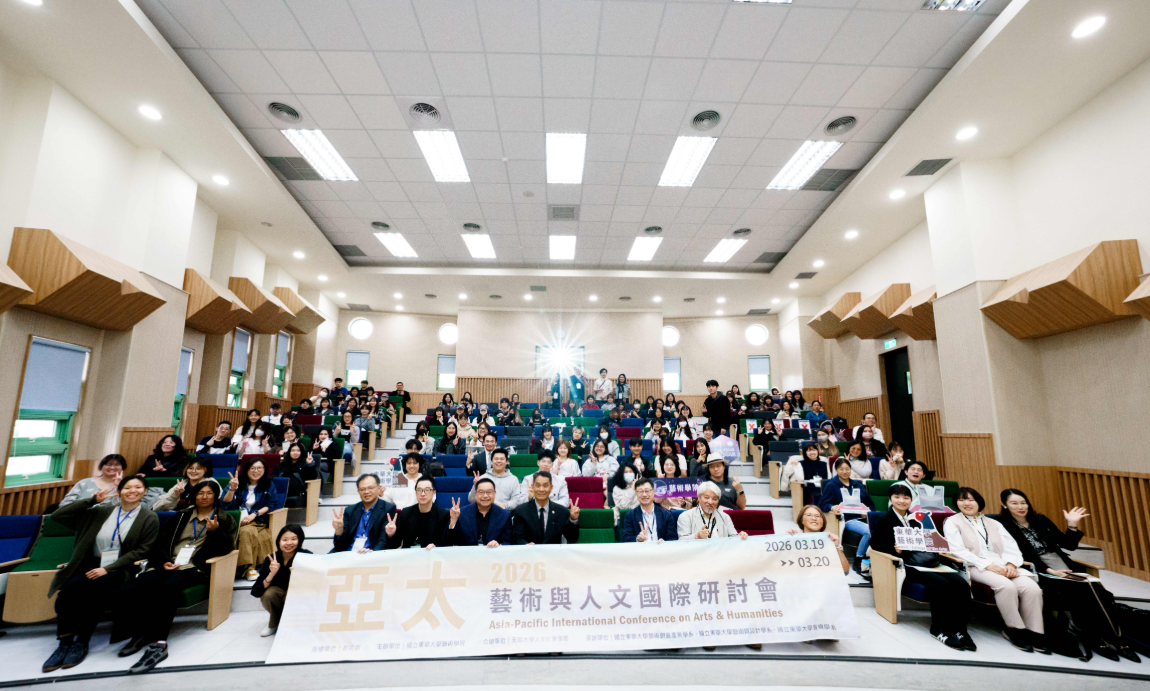
The College of Humanities and Social Sciences, Yuan Ze University, in collaboration with the College of the Arts, National Dong Hwa University, co-hosted the 2026 Asia-Pacific International Conference on Arts and Humanities—Art × Sustainability: Transformation, Action, and the Future.
The conference was held from March 19 to 20 at National Dong Hwa University, attracting scholars, artists, and practitioners from Taiwan and overseas. The event focused on the diverse roles of arts and humanities in advancing sustainable development.
Through keynote speeches, paper presentations, and interdisciplinary dialogues, the conference examined how arts and humanities responded to contemporary societal challenges. Topics included arts and humanities education, creative theories, technology and design transformation, the arts industry and local revitalization, as well as cultural practices in aging societies. These discussions highlighted trends in interdisciplinary integration and innovative potential. Scholars from the United States, Japan, Indonesia, and Taiwan were invited to deliver keynote speeches, enhancing the conference’s international outlook and level of academic exchange.
Chun-Hao Lee, EN-US, Dean of the College of Humanities and Social Sciences, Yuan Ze University, stated that amid rapid technological advancement and global structural transformation, sustainability issues were no longer confined to scientific and economic dimensions but required deep engagement from the humanities and the arts. He emphasized that the humanities and arts not only carried cultural value but could also be transformed—through interdisciplinary integration—into practical forces addressing challenges such as climate change, population aging, and digital transformation. He noted that this inter-university collaboration aimed to establish a platform for dialogue between academia and social practice.
Lee further noted that in recent years, the College of Humanities and Social Sciences, Yuan Ze University, had actively promoted interdisciplinary development under the framework of “Humanities × Technology.” By integrating artificial intelligence, digital humanities, and social policy research, the college strengthened its capacity to analyze public issues and cultivated talents equipped with data analysis skills and policy-oriented thinking. The initiative sought to incorporate technological applications into the humanities and social sciences and enhance their impact in the digital era.
During the conference, faculty members from Yuan Ze University served not only as speakers but also as session chairs and discussants in multiple paper presentation sessions. They provided constructive feedback on research design, theoretical frameworks, and practical applications, fostering exchanges among scholars from different disciplines and guiding discussions toward the linkage between sustainable development and social practice.
In addition, the event featured an opening concert, poster exhibitions, and a plenary forum, creating an exchange platform that integrated academic inquiry, artistic expression, and public engagement. The organizers noted that the conference functioned not only as a venue for presenting academic achievements but also as an important opportunity to promote collaboration among industry, government, academia, and research sectors, stimulate innovative thinking, and further translate theory into concrete action in response to the needs of sustainable development.
Yuan Ze University stated that it would continue to deepen inter-university and international collaborations, promote the integrated application of humanities, arts, and social sciences in digital transformation and sustainable development, and enhance Taiwan’s academic influence in the Asia-Pacific region through research in AI-driven humanities and public policy.