 EN-US
EN-US  ZH
ZH 
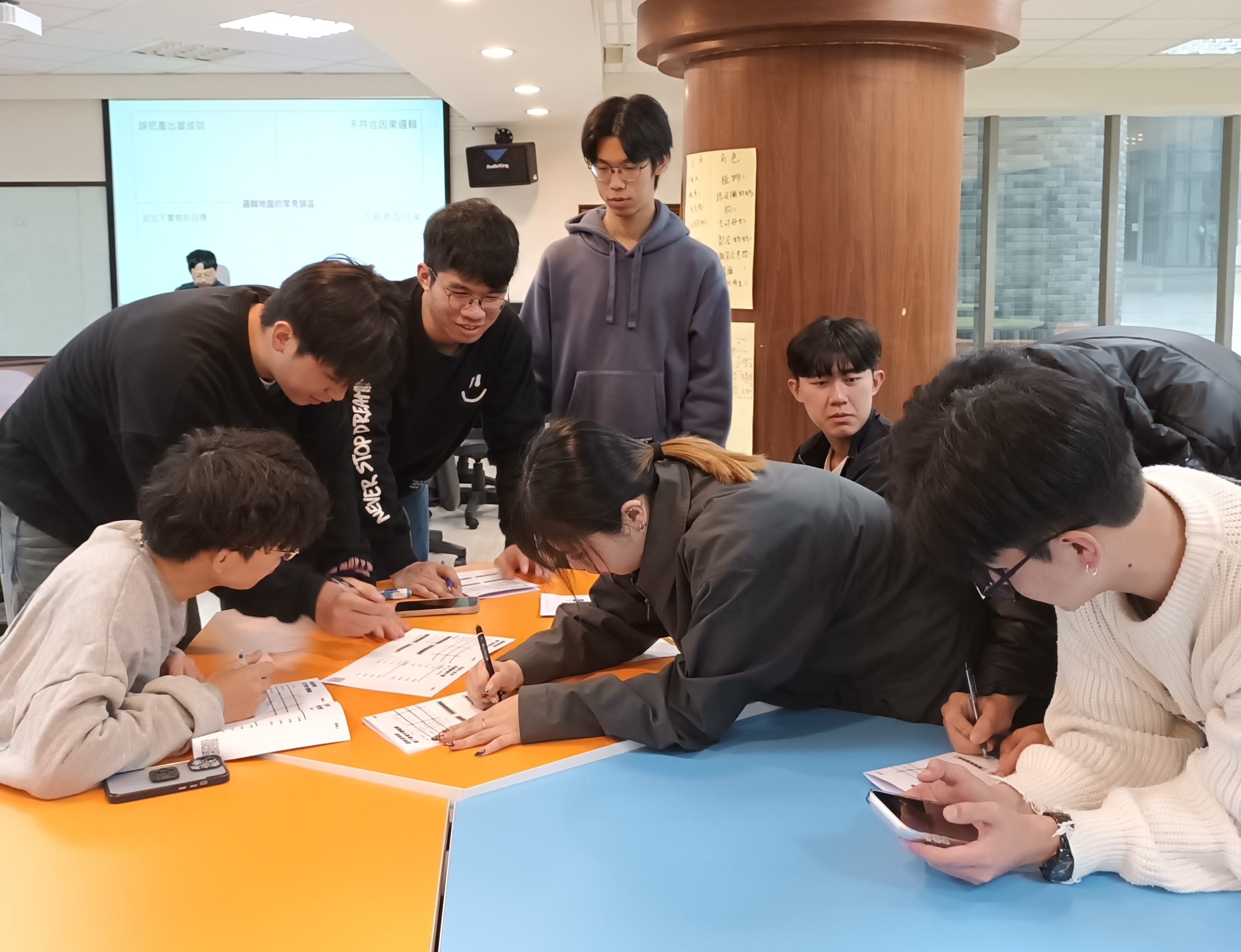
With support from the Ministry of Education’s Higher Education Sprout Project, the Happy Learning Camp at Yuan Ze University held a “Team Launch Project Planning Workshop.” The workshop invited instructor Chao-Wei Lin to guide participants in learning core project planning methods starting from service needs. Through conceptual instruction and hands-on practice, the workshop helped students transform ideas into concrete and feasible action plans, enhancing teamwork and execution efficiency.
The Happy Learning Camp at Yuan Ze University had long been planned and operated independently by students, with service areas covering after-school tutoring in rural areas, long-term care outreach, and services for people experiencing homelessness. Centered on the theme of “turning ideas into action,” the workshop aimed to assist students in building more complete project structures and division-of-labor mechanisms in service practice, while strengthening team communication and execution capabilities.
At the beginning of the course, Chao-Wei Lin used case sharing and video materials to guide participants in rethinking the essence of service learning and exploring what constituted truly effective service. Students started from the needs and circumstances of service recipients and reexamined whether their activity designs were genuinely needed and capable of creating real impact. Through discussion, participants gradually came to understand that service was not merely about completing activities, but about responding to real contexts and generating meaningful value.
In terms of project planning methodology, the instructor introduced four key dimensions—inputs, activities, outputs, and outcomes—to help participants analyze the logical relationships between different stages and translate abstract ideas into executable project plans. The instructor also pointed out common planning pitfalls, such as a lack of connection between activities and expected outcomes or overly idealistic goal setting, helping students improve the completeness and feasibility of their proposals.
To help participants more deeply experience the importance of teamwork, the course included interactive activities such as a “blindfolded block-stacking” exercise. In this activity, one commander with visual access guided blindfolded teammates to complete the task. The process tested trust and communication precision among team members and highlighted the critical role of the leader in integrating information, maintaining pace, and providing emotional support.
Many participants discovered through repeated attempts and adjustments that, in addition to clear instructions, timely encouragement and feedback could significantly improve team collaboration efficiency. For example, reminding teammates to slow down and stay calm often facilitated smoother cooperation than simply issuing commands.
In the latter part of the course, concepts such as Work Breakdown Structure (WBS) and the Responsibility Assignment Matrix (RACI) were introduced to help participants break down tasks and clarify roles and responsibilities. Many students took this opportunity to reflect on their roles within their teams, beginning to adjust previous habits of taking on all responsibilities themselves and learning to trust teammates and delegate appropriately, thereby further improving overall team operations.
Some participants shared that the most memorable aspect of the workshop was the experience of trust and communication gained through the hands-on activities. They noted that leaders needed to guide teammates through precise expression to complete tasks, which strongly tested trust and communication accuracy and prompted teams to reexamine their existing collaboration models.
Other participants stated that the workshop helped each team reach clearer consensus on semester goals. By clarifying project objectives at the outset, execution gaps could be avoided later. Teams also adjusted their division of labor, resulting in more balanced task distribution and clearer roles, further enhancing overall execution efficiency.
Yuan Ze University stated that through a complete learning process of concepts, practice, and reflection, the workshop not only helped students develop a needs-based project planning mindset but also enabled them to practice communication, collaboration, and leadership skills through interaction. In the future, teams in the Happy Learning Camp would continue to apply what they learned to service planning and action design, responding to real needs in service settings with more thorough preparation and further deepening the spirit of university social responsibility.