 EN-US
EN-US  ZH
ZH 
With support from the Ministry of Education’s Higher Education Sprout Project, Yuan Ze University promoted the Happy Learning Camp initiative, in which students independently planned and carried out diverse service activities. Ranging from academic tutoring to community outreach, the program continuously responded to the needs of different groups through concrete action. Recently, student teams visited a homeless service station, rural tutoring sites, and a long-term care center. Through hands-on experiences in different settings, students gained a deeper understanding of the value of service and witnessed the changes and meaning brought about by companionship.
On March 17, the Happy Learning Camp team visited the Taoyuan Ren-An Foundation Ping-An Station to participate in services supporting people experiencing homelessness. Students assisted with warehouse organization and material sorting, dividing tasks such as moving supplies, arranging storage, and cleaning spaces. Through their efforts, accumulated supplies were systematically organized, the environment was improved, and two rooms were prepared for temporary accommodation. Participating students shared that although their work did not involve direct interaction with service recipients, they still felt they were quietly contributing to the support system for others. The experience helped them better understand the preparation and dedication required behind diverse services and brought a strong sense of accomplishment.
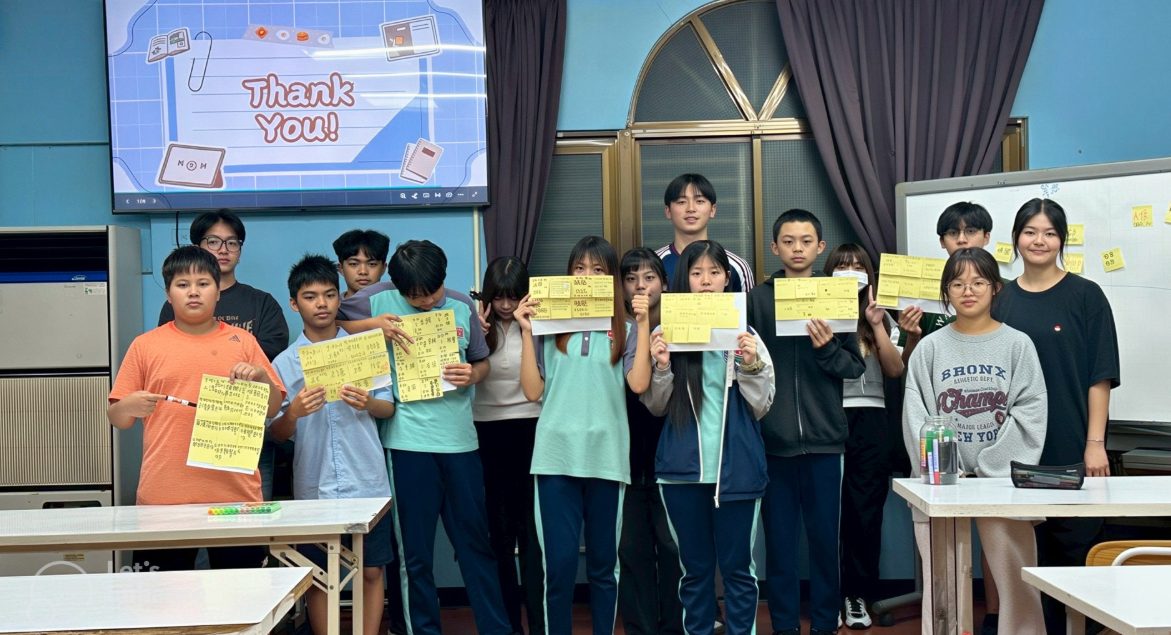
On March 18, the team traveled to Dayuan Catholic Church to conduct extracurricular learning activities for junior high school students in rural areas. Focusing on the theme of time management, the program introduced methods such as the Eisenhower Matrix and the Pomodoro Technique, combined with case discussions and practical strategies, to help students build concepts of task planning and focused execution. During the sessions, the team observed that abstract concepts were initially difficult for students to grasp, so they incorporated more everyday examples and interactive questioning to help students relate the ideas to their own academic and daily schedules. Gradually, students shifted from passive listening to active participation, beginning to think about priorities and time allocation. The team expressed hope that through long-term companionship and continuous encouragement, students would find direction during uncertain stages and further develop interest in learning and self-management skills.
On March 22, the team visited Dongyang Long-Term Care Center to carry out services for older adults. Activities included warm-up exercises, painting, singing, and interactive games, aiming to convey care and warmth through companionship and interaction.
At the beginning, some residents remained quiet and observant. As students proactively offered companionship, patient interaction, and encouragement, the atmosphere gradually became more lively. Many residents moved from observing to actively participating and began sharing their life stories and thoughts.
The team pointed out that the most important aspect of long-term care services was not the activities themselves, but the trust and connection built through interaction. When residents were willing to open up, respond actively, and engage in activities, it became the most valuable form of feedback. The sense of being needed and accepted also made the overall service experience more profound.
Yuan Ze University stated that through service practices across multiple settings and dimensions, the Happy Learning Camp enabled students to cultivate empathy and problem-solving skills through different roles, including logistical support, instructional guidance, and companionship. In the future, the teams would continue to engage with more service sites, learning through service and growing through learning. By allowing learning and service to complement each other, students aimed to expand positive impact through concrete action and further deepen the practice of university social responsibility.