 EN-US
EN-US  ZH
ZH 
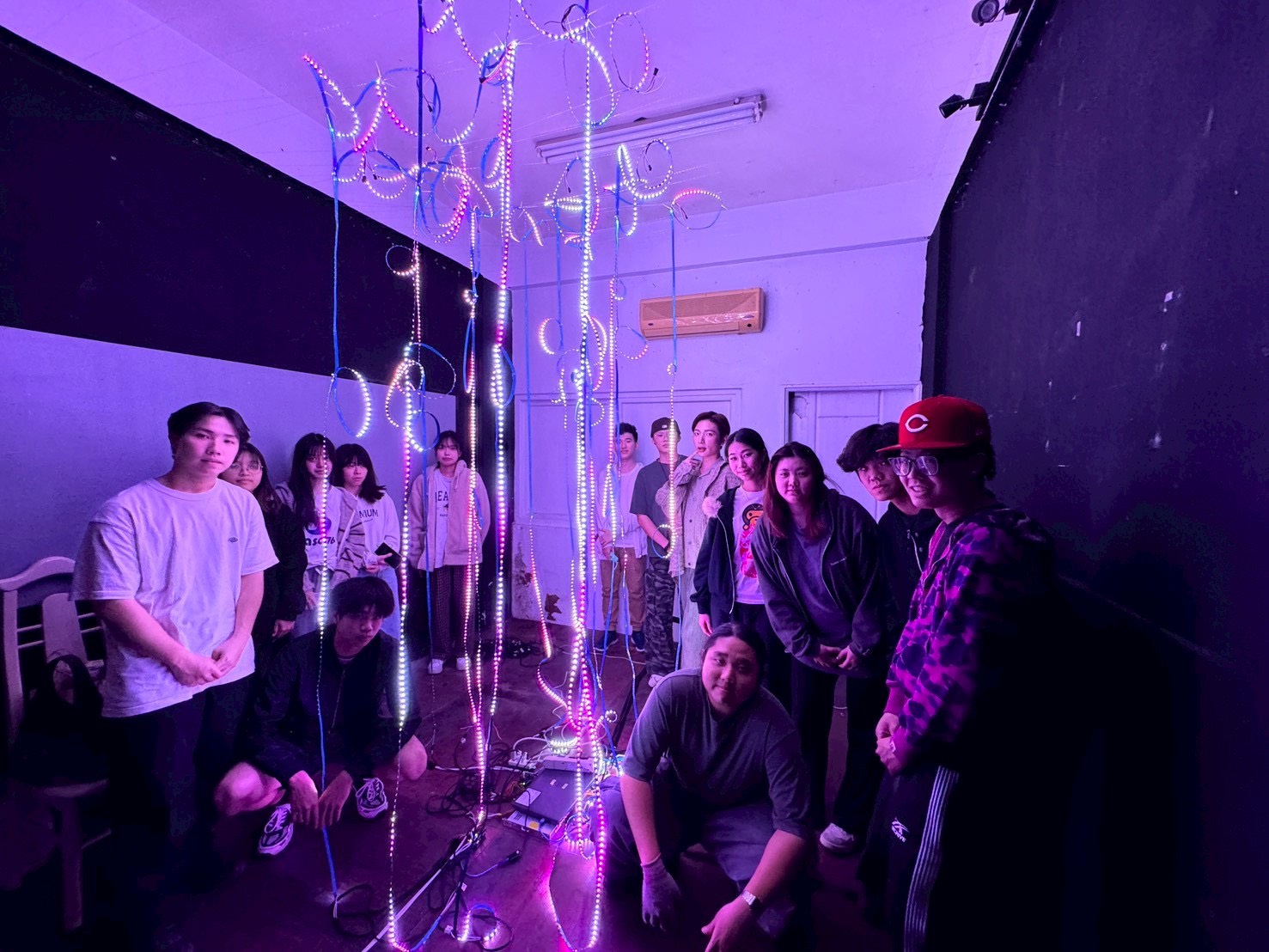
To strengthen the connection between design education and real social contexts, the Department of Art and Design at Yuan Ze University held an Interactive Design Workshop in Neili, Taoyuan. The workshop invited several well-known professionals from Taiwan’s creative industries to jointly mentor students, guiding them into the community to engage in cross-disciplinary design creation and spatial transformation experiments rooted in local daily life. The event showcased the outcomes of integrating design education with local practice.
Course instructor Jiahui Luo stated that the workshop was themed “Hidden Landscapes,” emphasizing local perception and design translation. Through field research, students collected sounds, images, and everyday objects from residents’ daily lives, and conducted observations and reinterpretations within underutilized spaces. They explored the cultural significance and potential reuse of these spaces. By means of video documentation, sound collection, interactive installations, and projection mapping, students transformed familiar daily elements into artistic works that encouraged public participation, presenting everyday environments in a renewed and imaginative form.
The workshop specially invited several distinguished industry mentors, including Yanbo Ye, co-founder of Heli Interactive; Yuhao Li, Ziliang Chen, and Junwei Hsu from Kurokawa Interactive Media Art; sound kinetic artist Naiquan Zheng; and Bing‑Hua Tsai, founder of BLND Academy. Through an educational model that combined industry mentor residency with real-world sites, the mentors guided students from conceptual development to practical implementation. Jiahui Luo emphasized that interactive design was not merely about form-making, but about responding to social needs. Through engagement with industry professionals and local observation, students gained a concrete understanding of how design operated within real-world contexts.
Third-year undergraduate student Xuanyu Lü shared that under the guidance of industry mentors and through intensive hands-on practice, he not only expanded his imagination of interactive design but also learned how to transform creative ideas into tangible works. Graduate student Ci Yin noted that participating in the workshop as a staff member allowed her to deeply appreciate the importance of teamwork and project execution, while interactions with community residents further deepened her understanding of the meaning and value of design.
Shengli Lin, the village head of Neili, stated that the Department of Art and Design at Yuan Ze University had long been deeply engaged in the local community. Through sustained involvement, the department had gradually built residents’ trust in design interventions, making art and design a vital force in community revitalization.
The outcomes of the workshop were presented through open-air exhibitions in neighborhood alleys, inviting faculty members, students, and residents to participate and experience the works together. This approach allowed the design to step beyond the campus and directly respond to local contexts. Director Chor Kheng Lim pointed out that, in the face of industry transformation driven by AI technologies, design education needed to further strengthen industry connections and practical skills development. Through industry mentorship and local collaboration, the workshop enhanced students’ cross-disciplinary integration skills and laid a solid foundation for their future careers in the design industry.
The Department of Art and Design at Yuan Ze University added that the workshop was supported by the Taoyuan City Government Youth Affairs Bureau, demonstrating the potential of design education that integrated local revitalization and industry practice. The department stated that it would continue to promote similar cross-disciplinary, practice-oriented initiatives to cultivate design talents equipped with both innovation and practical execution capabilities.