 EN-US
EN-US  ZH
ZH 
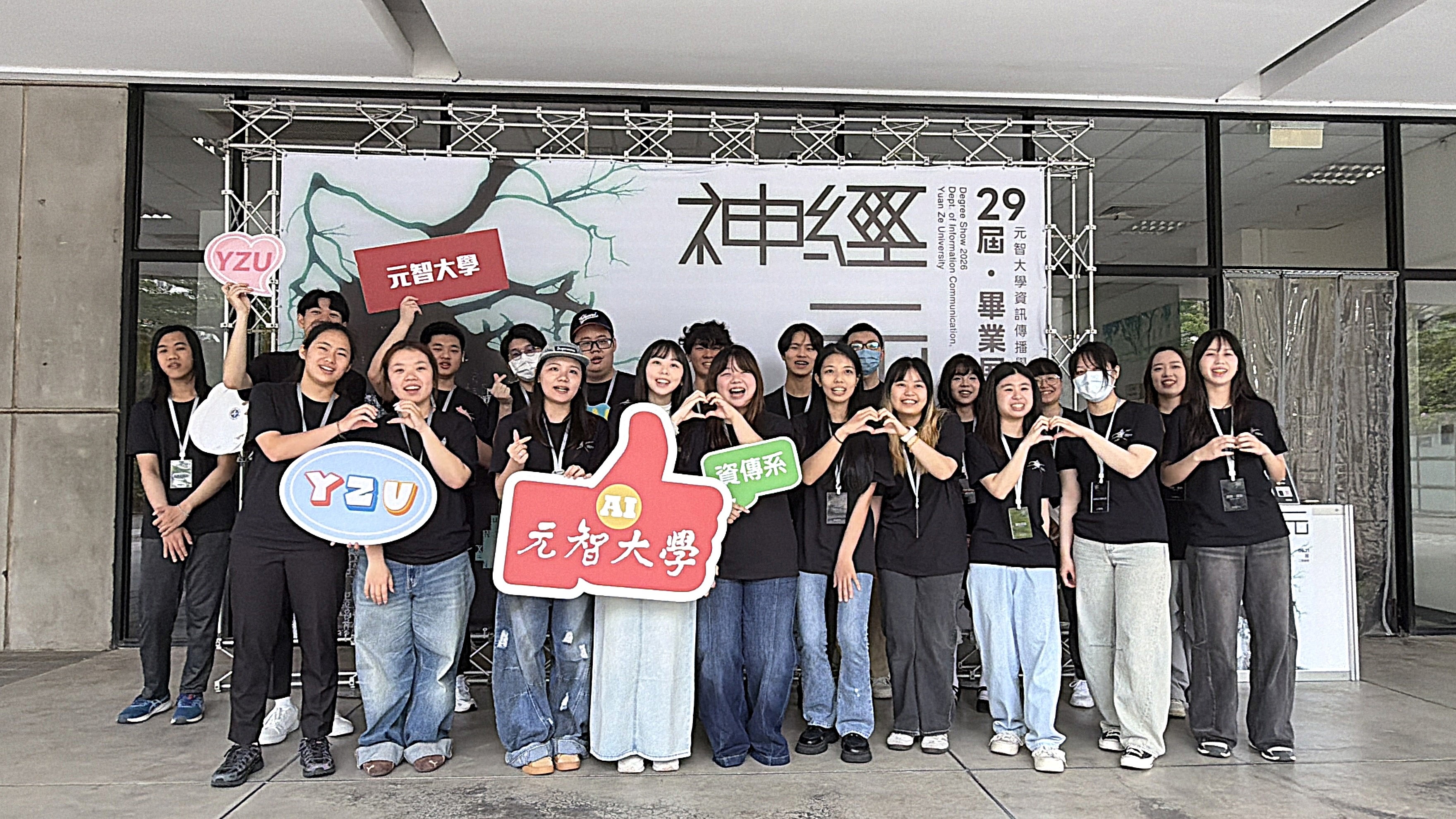
The 29th Graduation Exhibition of the Department of Information Communication, Yuan Ze University, titled Neuron, was held from May 8 to May 11 at Warehouse No. 2 of Songshan Cultural and Creative Park in Taipei. The exhibition showcased 19 student works, spanning a wide range of fields including interactive installations, game design, film and animation, and integrated marketing. The diverse presentations highlighted students’ achievements in interdisciplinary learning and creative practice.
Centered on the interweaving of sensibility and rationality, Neuron symbolized how the younger generation established connections, translated ideas, and formed their own perspectives in an era of high-speed information flow. Much like neurons connecting to form networks of thought in the human brain, the exhibition reflected Generation Z’s creative thinking and their ways of engaging with the world.
Several works in the exhibition demonstrated students’ multifaceted observations of contemporary digital culture, narrative thinking, and everyday life issues. Among them, the interactive experience Touch.zip was co-created by Koshiro Ozaki, Hsing-Yi Chiang, Chih-Yu Ko, Kai-Shao Chang, Chun-Yu Lee, and Chen-Hao Liao. Focusing on language evolution and intergenerational communication, the work metaphorically described increasingly simplified text in the social media era as a “compressed file.” Chun-Yu Lee explained that through interactive design, the work guided audiences to reflect on how emotions and meanings continued to be conveyed and understood even within highly condensed forms of expression.
The game project Nis of the Godless Land was jointly created by Po-Shuo Chang, Chin-Ling Wu, Kai-Chuan Yang, Chi-Hua Cheng, Tung-Ting Tsai, and Yao-Peng Chung. Kai-Chuan Yang noted that the work was a narrative-driven 2D travel and combat game in which players assumed the role of the protagonist “Lan” and embarked on an exploratory journey with the priest “Nis.” Combining side-scrolling mechanics with synchronous turn-based battles, the game gradually revealed the truth of the world through interactions with NPCs and narrative progression.
Drive Me Crazy was co-created by Kai-Lin Huang, Sheng-Hung Hsiao, Cheng-Yu Kang, Yun-Hao Tseng, and Chin-Wei Chou. Addressing modern society’s heavy reliance on smartphones and increasingly fragmented attention spans, the project reinterpreted attention testing through gamified interaction. Sheng-Hung Hsiao stated that the work constructed a surreal driving scenario integrating intense visual stimuli and AI recognition technology to analyze viewers’ distraction responses during the experience. Through immersive gameplay, the project invited audiences to reflect on the issue of attention loss in an era of information overload.
Ephemeral Cache was created by Wan-Ping Chuang, Chih-Ling Chou, Chia-Chun Hung, Yu-Meng Chiang, Chia-Yu Chang, and Szu-Yu Chen. Wan-Ping Chuang explained that the work took the “age of documentation” as its point of departure, observing how people often overlooked questions of self-existence while constantly leaving behind digital and life traces. Through sensory interaction and action-based choices, the team invited audiences to slow down and reconsider what it meant to be recorded and remembered, responding to questions of existence within fleeting experiences.
The marketing proposal NOVUS was co-created by Hsing-Yu Chen and Chiao-Yin Chuang. Chiao-Yin Chuang stated that the project focused on adaptation to new environments and psychological support, integrating digital interaction and service design concepts to propose a marketing strategy that balanced emotional companionship and self-management. The work addressed the pressures and emotional adjustment needs faced by younger generations in campus life.
Chin-Hung Teng, Director of the Department of Information Communication, remarked that the graduation exhibition was not only a presentation of students’ learning outcomes, but also a concrete demonstration of their thinking and practical abilities. Through creative works responding to social issues, students showcased their interdisciplinary competencies, integrating technology, humanities, and design. He further noted that the Department had long emphasized the integrated development of “Technology Applications × Narrative Thinking × Marketing Practice.” Through practice-oriented courses in interactive technology, digital content production, and integrated marketing, the Department aimed to cultivate students with the adaptability and creative thinking required to navigate the rapidly evolving digital media environment, and to continue nurturing interdisciplinary professionals for the new media and content industries.