 EN-US
EN-US  ZH
ZH 
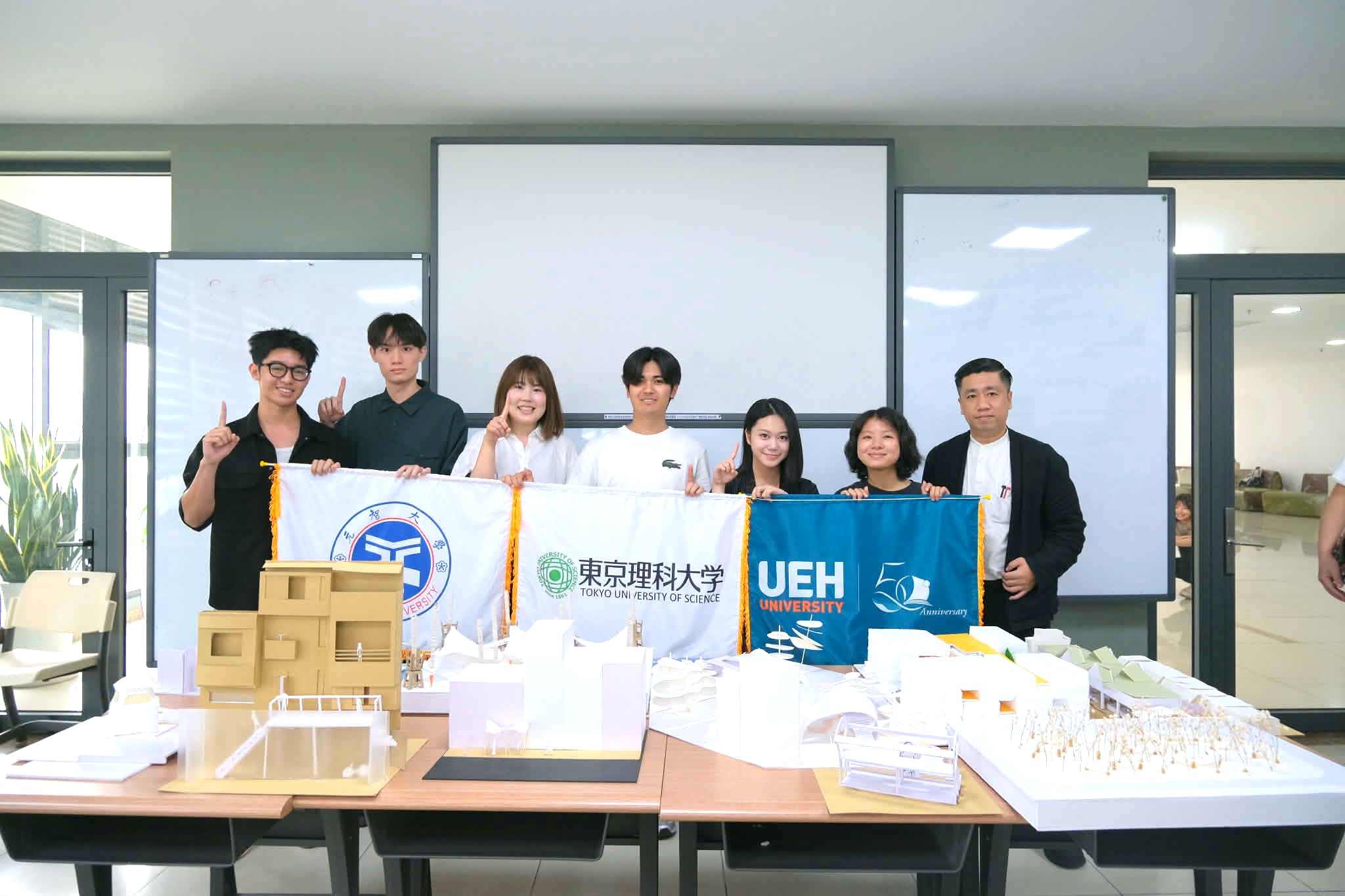
Yuan Ze University had long emphasized international exchange and academic collaboration. In response to contemporary urban and environmental issues, the Department of Art and Design recently partnered with the Department of Architecture, Tokyo University of Science (Japan), and the College of Technology and Design, University of Economics Ho Chi Minh City (Vietnam) to jointly host the international design workshop “Reading Our Cities.” The four-day cross-national exchange and design practice was held in Ho Chi Minh City, Vietnam, bringing together faculty members and students from Taiwan, Japan, and Vietnam.
The workshop gathered participants from the three countries to rethink the humanistic and environmental challenges faced by Asian cities amid rapid development through urban observation, cultural research, and design proposals. Centered on the theme of “reading the city,” the program guided students to explore interactions between people and cities, as well as between people and nature, from multiple perspectives, including architectural space, public environments, everyday urban textures, and environmental perception.
During the workshop, participating students conducted on-site visits to neighborhoods across Ho Chi Minh City, closely observing the city’s diverse and vibrant urban landscape. Through mixed international team formations for discussion and creation, students generated rich exchanges of ideas, sparking diverse interpretations and design imaginations of urban space shaped by different cultural backgrounds. The outcomes demonstrated the substantial achievements of cross-cultural collaborative learning.
The workshop was jointly guided by professors from the three universities and was further enriched by the participation of six practicing architects based in Ho Chi Minh City, who were invited to engage in dialogue and project critiques. They shared practical experiences related to urban regeneration, architectural design, and public space development in Vietnam. Through interdisciplinary exchanges between academia and professional practice, students were able to gain deeper insights into real-world urban development and environmental challenges.
Jia-Hui Luo, a faculty member from the Department of Art and Design, Yuan Ze University, noted that in an era of rapid globalization and digital technological advancement, design education was no longer confined to formal or aesthetic training alone. Instead, it increasingly emphasized interdisciplinary integration, international perspectives, and social responsiveness. Through this international workshop, students not only accumulated valuable cross-cultural collaboration experience but also learned to respond to real-world urban and environmental issues through research-driven design.
Chu-Ching Lin, Director of the Department of Art and Design, pointed out that the Department had long placed strong emphasis on international collaboration and sustainability issues. In recent years, it has actively promoted the integration of artificial intelligence and design education and established an AI Innovation Track, aiming to cultivate a new generation of design professionals equipped with both digital technology capabilities and humanistic thinking. She added that the workshop also encouraged students to consider the application of AI and digital tools in urban studies—from data analysis and environmental sensing to future spatial imagination—exploring the critical role of design in smart cities and sustainable development.
Looking ahead, the Department of Art and Design, Yuan Ze University, stated that it would continue to deepen international exchange and interdisciplinary collaboration. By integrating AI technologies with design practice and working closely with overseas academic and industry partners, the Department aimed to build an innovative design platform that combined technology, humanity, and environmental care.