 EN-US
EN-US  ZH
ZH 
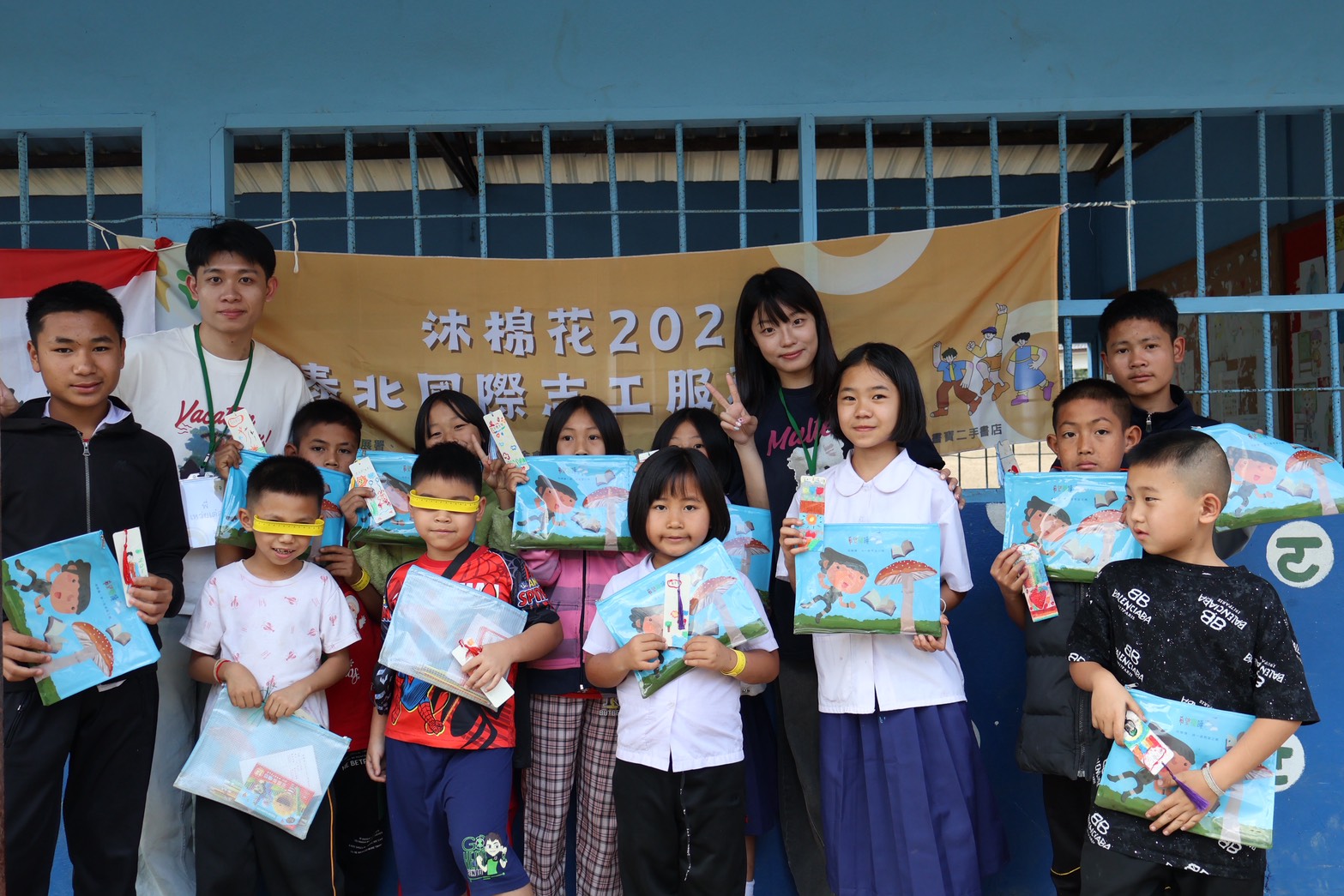
During the 2026 winter break, Yuan Ze University launched the “Mumianhua Northern Thailand International Volunteer Program,” sending a cross-university volunteer team to Hanguang Elementary School in Chiang Rai, Thailand, to carry out international service activities.
Centered on service continuity and cross-university professional complementarity, the initiative progressed from foundational teaching to the establishment of digital learning resources, demonstrating Taiwanese youth’s long‑term commitment to international education in practice.
The program was supported by the ASUS Foundation, the CommonWealth Magazine Education Foundation, and the Tzu Chi Foundation, and built upon on‑site observations and needs identified during the previous summer’s service. Initiated by Yuan Ze University, the volunteer team brought together eight students from National Taiwan University, National Chengchi University, Feng Chia University, and National Kaohsiung University of Science and Technology. With backgrounds spanning education, technology, and project planning, the team worked through cross‑university collaboration and task division to enhance overall service effectiveness.
Qihao Huang, a Yuan Ze University alumnus who had participated in the previous summer’s service and was then enrolled in a graduate program at National Taiwan University, rejoined the winter volunteer team. He noted that the purpose of sustained engagement was to deliver educational resources to communities where they were truly needed, rather than limiting efforts to short-term experiences. He emphasized that bridging educational gaps constituted the core value of long-term volunteer action.
In terms of instructional design, cross-university team member Yijun Lai observed variations in students’ Mandarin proficiency and therefore planned a bookmark‑painting workshop integrated with reading guidance. This approach helped students develop concepts of book usage and management. Another Yuan Ze University volunteer, Wenhui Zheng, pointed out that cross-university collaboration not only enhanced teaching outcomes but also allowed participants to reconnect with the original motivation for learning and to build deep partnerships through shared experiences.
Student Meimei Zhang from Hanguang Elementary School shared that her favorite activity was the bookmark workshop, where she could draw things she liked. She expressed gratitude to the volunteer teachers for accompanying them in class and teaching them how to read and use books. Through the program, she learned how to organize books and became more confident in expressing her thoughts in Chinese. She noted that being accompanied and seen made her feel truly supported and happy, while the courses helped her develop reading habits, basic book management skills, and greater language confidence through expression and interaction.
Resource integration was also a key focus of the initiative. The team collected second‑hand computers and received donated children’s books, stationery, and teaching materials from various organizations, including Eslite, the Hsin Yi Foundation, and the Boyo Social Welfare Foundation. In total, more than 130 kilograms of supplies were gathered to help establish a multifunctional library that combined physical reading, digital learning, and exploratory play, providing a sustainable learning base for long‑term use.
Beyond classroom teaching, the volunteer team also conducted home visits to disadvantaged families within the community, extending care to the household level. The team observed that insufficient educational resources were often intertwined with living conditions. With the support of non-governmental organizations, family challenges could be alleviated while enabling students to deepen their sense of social responsibility and public engagement through service.
To strengthen institutionalized collaboration, Yuan Ze University also signed a long-term memorandum of understanding with Datong High School in Northern Thailand during the visit. Future cooperation would continue in areas such as curriculum support, digital resource development, faculty and student exchanges, and volunteer training, transforming one-time service activities into a cumulative and sustainable educational support mechanism. Professor Hsiu‑Chu Lin, the program advisor, stated that this marked the team’s first overseas service during a winter break. The experience not only validated the feasibility of cross-university collaboration but also, through systematic planning and alumni participation, successfully transformed short-term actions into long-term companionship.
Yi‑Chun Liu, Dean of Student Affairs, Office of Student Affairs, Yuan Ze University, emphasized that cross-university collaboration and resource integration were key to the sustainable development of international volunteer programs. She noted that the University would continue to unite the strengths of higher education institutions and enterprises, enabling educational support to deepen steadily through intergenerational and interdisciplinary cooperation, while accompanying children in remote areas as they broaden their horizons and reshape their futures.