 EN-US
EN-US  ZH
ZH 
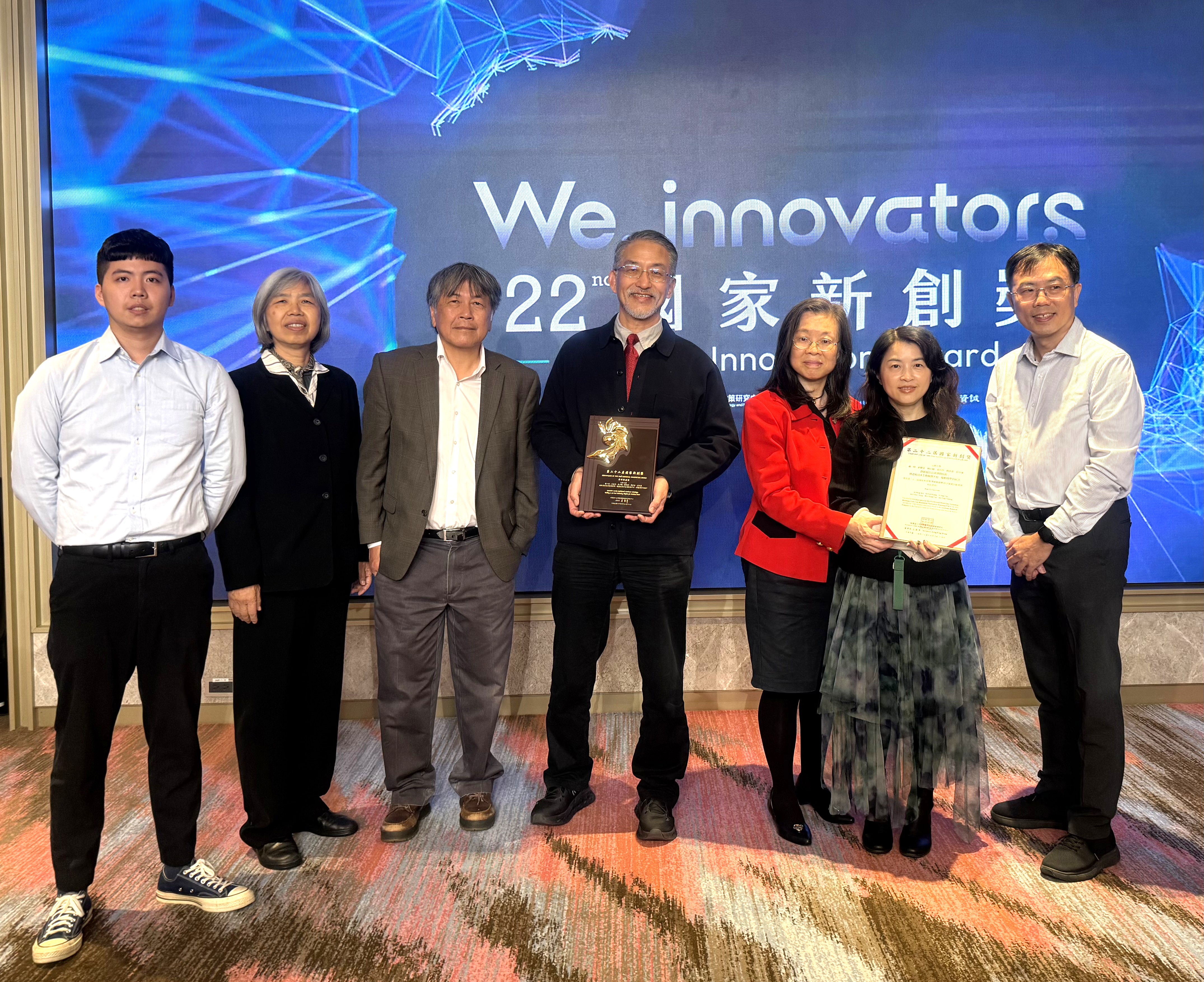
A cross-disciplinary research and development team led by I-Ming Sun, Professor and Dean of the College of Engineering at Yuan Ze University, collaborated with Hsueh-Chia Chang, Endowed Chair Professor and Yushan Scholar at the University of Notre Dame, to jointly develop an innovative thin-film biosensing technology.
The team was awarded the 22nd National Innovation Award in the category of Innovative Medical Devices and Diagnostic Technologies (Academic Research-Based Startup Award), the highest honor in Taiwan’s biomedical innovation sector. The team had also recently been invited to the United States to participate in the CREATE-X Program, the flagship annual startup initiative of the Georgia Institute of Technology, where they stood on an international stage alongside top-tier venture capitalists and startups. This invitation clearly demonstrated Yuan Ze University’s outstanding capability to successfully translate academic research into technologies with strong commercial application value.
The award-winning team showcased a high level of interdisciplinary integration. I-Ming Sun led the core thin-film design and probe modification technologies; Li-Fen Huang, Professor at the Graduate School of Biotechnology and Bioengineering, was responsible for biological probe design and validation; Yu-Chen Chang, Associate Professor in the Department of Chemical Engineering and Materials Science, led the development of a commercialization-oriented prototype system; and Yi-Nan Lin, Ph.D., coordinated overall project integration and execution. Core team members also included Yuan Ze University students Chieh-Ning Chuang and Hsu-Hung Kuo from the Department of Chemical Engineering and Materials Science, who were responsible for thin-film fabrication and detection method development. Through this process, research advancement and talent cultivation progressed in parallel, yielding substantial outcomes.
The thin-film biosensing technology integrated industrial design with smart healthcare applications. Both the biosensing instrument and the thin-film biosensor chips were completed with the support of high-quality Taiwanese partners capable of mass production. From key components and exterior design to mechanical structure, the technology fully embodied the concept of “Made in Taiwan (MIT).” In addition, the Yuan Ze team independently developed in situ-synthesized homogeneous thin-film sensing elements with mass-production potential, as well as scalable microfluidic biochip sensors. Through diversified probe designs, the technology effectively overcame the time-consuming and high-cost limitations of conventional diagnostic methods, achieving rapid, precise, and cost-effective genetic testing.
The technology was expected to be widely applied in clinical medicine, food safety, disease prevention, and environmental monitoring, and it closely aligned with the United Nations Sustainable Development Goals (SDGs), balancing technological innovation with social responsibility.
Regarding the National Innovation Award recognition, I-Ming Sun stated that academic research should not be limited to journal publications; more importantly, it should move beyond the laboratory and be transformed into products that address real market needs. He noted that a key factor behind the award was the team’s adoption of a platform-based approach, positioning the technology as an expandable diagnostic platform. By simply replacing different biological probes, the system could be adapted to diverse application scenarios, demonstrating strong commercial feasibility and significant potential for industry integration.
Before receiving recognition from the National Innovation Award, the technology had already gained prominence on the international stage. It had won First Prize at the CIC Asia (Convergence Innovation Competition Asia) and had been invited to participate in the CREATE-X Demo Day at the Georgia Institute of Technology, where the team presented its achievements directly to global investors, demonstrating its competitiveness in overseas markets.
Hsu-Hung Kuo, a researcher who had long been involved in both the technological development and commercialization process, pointed out that product development differed greatly from pure academic research, as it required addressing challenges such as cost control, yield rates, and user experience. He emphasized that such efforts relied heavily on cross-disciplinary collaboration and expressed hope that the team’s experience with the National Innovation Award and related competitions could serve as a reference for research teams aspiring to bring academic achievements to industry.
The Yuan Ze University Thin-Film Biosensor team expressed sincere gratitude to the Hsu Yao-Hsiang Memorial Foundation and the Yuan Ze Hsu Memorial Foundation for their support in research and travel funding, as well as to Far Eastern New Century Corporation for providing technical consultation. Looking ahead, Yuan Ze University stated that it would continue to deepen industry–academia–research collaboration, advance biomedical startup technologies, and enable Taiwan’s research and development strengths to continue shining on the global stage.