 EN-US
EN-US  ZH
ZH 
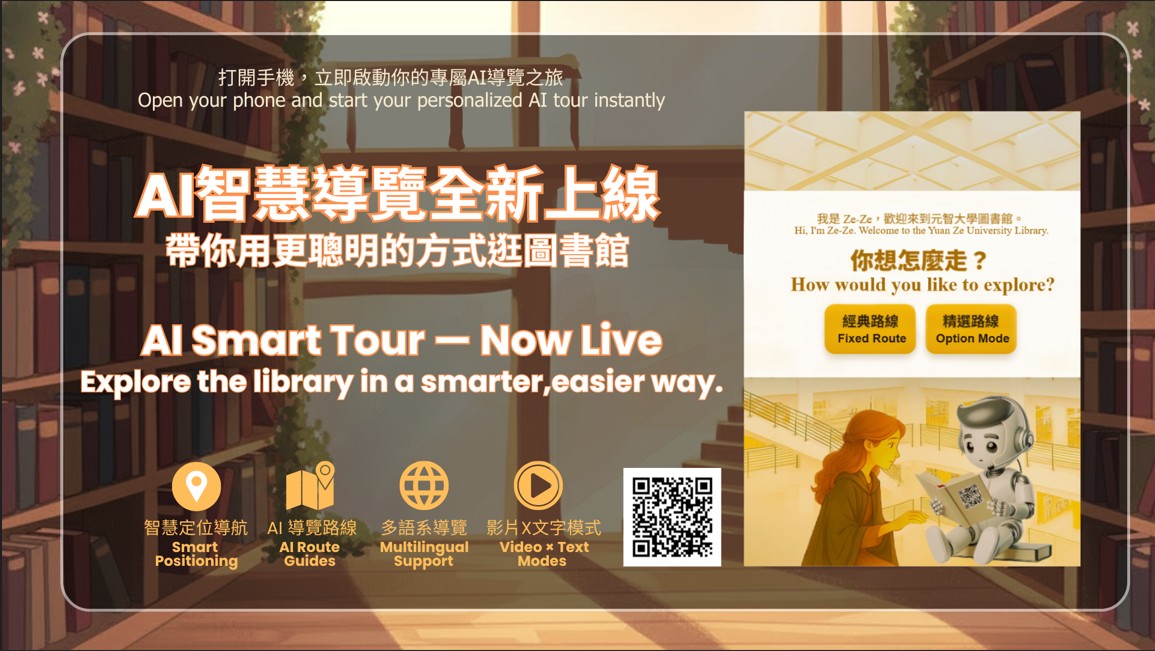
In response to the rapid development of AI technologies and the growing internationalization of its campus, the Yuan Ze University Library launched an “AI Smart Voice Navigation Service,” creating an upgraded visitor experience through multilingual support, location-based intelligence, and interactive content.
By simply scanning a QR code at the entrance with a mobile phone, users were able to activate multilingual voice guidance. With real-time positioning and interactive features, the service offered an experience akin to having a personal guide accompanying visitors as they freely explored the library.
Ren-Zan Wang, Chief Information Officer of Yuan Ze University, stated that the AI navigation system provided two modes—“Classic Route” and “Featured Route”—and supported video, audio, and text content. The diverse content design accommodated various usage scenarios. At the time of launch, 11 guided locations were installed throughout the library, covering architectural features, collections, and themed spaces. Visitors could freely customize their routes based on their needs, significantly enhancing flexibility and convenience.
Wang pointed out that the system’s most distinctive feature was the integration of location-based positioning and AI image recognition technologies. These technologies enabled the system to identify users’ real-time locations and automatically plan the next stop. Users no longer needed to rely on complex floor maps or repeatedly confirm directions, as AI provided intuitive navigation suggestions. This innovation reduced the likelihood of first-time visitors getting lost and made the overall experience smoother and more user-friendly.
To accommodate the steadily increasing number of international visitors, the AI navigation service was made available in Chinese, English, and Japanese, allowing users to switch languages according to their preferences and enhancing cross-cultural accessibility. Combined with intelligent positioning and visualized floor maps, the service delivered a more comprehensive visitor experience and demonstrated the library’s commitment to internationalized services.
To promote the new function, the library introduced an “AI Real-World Puzzle Challenge” in September. Participants followed clues to complete challenges throughout the library, reinforcing spatial memory and familiarizing themselves with the navigation system through gamified interaction. The activity attracted a large number of students and received enthusiastic feedback.
The system was co-developed by the library and graduate student Chien-I Yang from the Department of Computer Science and Engineering, serving as a concrete outcome of the university’s “Smart Campus” initiative and its emphasis on interdisciplinary talent cultivation. Wang noted that the team would continue to optimize the user interface, expand navigation content, and introduce additional interactive modules, transforming navigation from a simple directional tool into a journey of knowledge exploration.
Wang emphasized that the AI smart voice navigation service was expected to become a “digital concierge” for both on-campus and off-campus visitors. Whether for new student orientation, academic visits, or international guests, the system enabled users to understand the library more intuitively. “With just a mobile phone,” he said, “the library could accompany you in exploring the possibilities of knowledge.”