 EN-US
EN-US  ZH
ZH 
The 16th Graduation Exhibition of the Department of Art and Design, Yuan Ze University, titled “Valid Proof: An Ongoing Silent Process,” was held at Warehouses 3 and 11 at Chung Yuan Cultural and Creative Park. The exhibition brought together the creative works of graduating students accumulated over the years, presenting a total of 20 pieces. Through diverse media and interdisciplinary forms of creation, the works had responded to contemporary society, personal life experiences, and local cultural issues, demonstrating the keen observation and abundant artistic practice of young creators.
Director Chor-Kheng Lim of the Department of Art and Design, Yuan Ze University, had stated that the theme “Valid Proof” symbolized how students had continuously engaged in observation, questioning, experimentation, and verification throughout their creative processes, ultimately completing an in-depth dialogue between the self and the world. The exhibition not only presented final works but also preserved traces of thinking and experimentation, allowing audiences to gain insight into the complete trajectory from concept development and material exploration to artistic realization.
The exhibited works covered artistic creation, design experimentation, cultural studies, and social observation, fully demonstrating the long-term achievements of the department in promoting interdisciplinary integrated teaching. Among them, Chieh-Jung Chien’s work “Colors on the River” had centered on the local culture and industrial memory of Daxi, Taoyuan. Through field investigations, interviews, and material experimentation, industrial by-products such as tea residues, coffee grounds, and incense ash had been transformed into crayons and scented candles, reinterpreting local colors and life memories. The work not only addressed issues of sustainable design and the circular economy but also demonstrated innovative possibilities for design to engage in local revitalization and cultural preservation.
Hsiao-Ching Huang’s work “Domesticated Body” had taken bodily experience as its starting point, exploring the long-term anxiety and internal depletion faced by modern individuals. By presenting repetitive behaviors and bodily responses, the work had transformed abstract emotions into tangible perceptions, depicting the complex relationship between self-regulation and emotional tension, and prompting deeper reflection on physical and mental states.
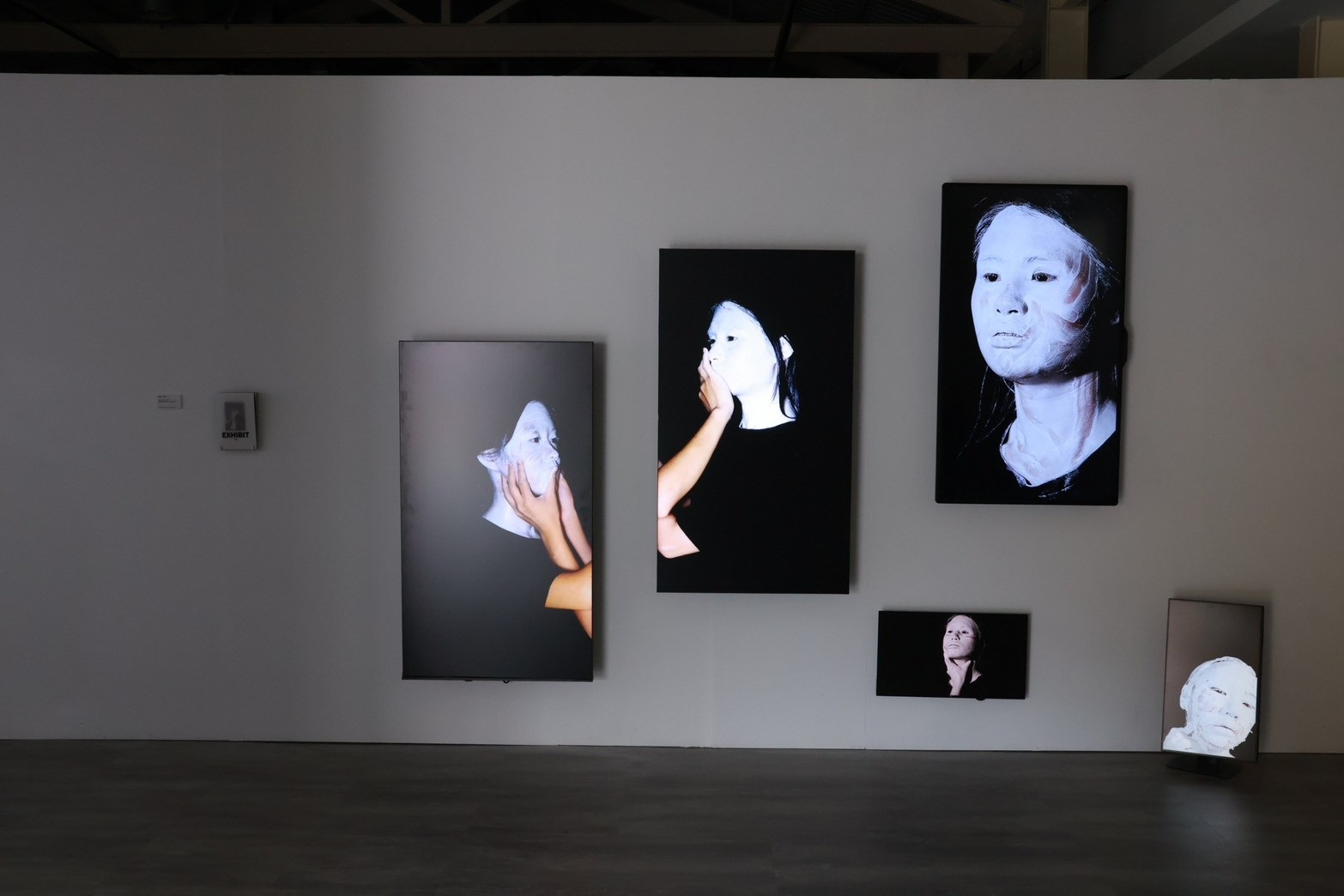
Yu-Hsuan Tsai’s work “EXHIBIT” had focused on the relationship between “seeing” and “being seen.” Through transformations between human and object forms, the work had explored how gaze shaped individual perception and identity, presenting the nuanced observations of new-generation creators on social interaction and psychological states.
Tzu-Hsun Tseng’s work “Shadows Beneath Words” had used language communication as its medium. By applying artificial intelligence to analyze emotional tendencies in human speech, the work translated semantic nuances—from sharp to gentle—into mechanical movements, light and shadow, and dynamic bubble displays. Through the interactive relationship among bubbles, water reflections, and projections, the installation had materialized implicit meanings into visible “shadows beneath words,” guiding audiences to rethink the subtle connections among language, emotion, and interpersonal communication, while also demonstrating the innovative potential of integrating AI technologies into design creation and interactive art.
Chor-Kheng Lim had noted that in response to the rapid development of digital technologies and artificial intelligence, the Department of Art and Design, Yuan Ze University, had continued to deepen the interdisciplinary integration of art, design, and technology. In recent years, emerging technologies such as artificial intelligence (AI), generative design, digital image creation, and interactive media had been actively incorporated into the curriculum. This approach has cultivated a new generation of talents equipped with both creative thinking and technological application capabilities. In addition to building a solid foundation in artistic creation and design, students had also learned to utilize AI tools for creative ideation, visual generation, digital storytelling, and cross-media experimentation, enhancing their competitiveness in the face of future industrial transformations.
Chor-Kheng Lim had further indicated that Yuan Ze University possessed strong foundations in information technology, engineering, and management, allowing the Department of Art and Design to fully leverage interdisciplinary resources across colleges. Students had been encouraged to integrate artificial intelligence, interactive technology, digital content, and cultural and creative fields into their creative practices. Through interdisciplinary projects, industry–academia collaboration, and exhibition practices, students had been able to engage with AI applications and innovative design trends during their studies, cultivating problem-solving, integrative innovation, and cross-disciplinary collaboration capabilities.
This graduation exhibition had not only served as a comprehensive presentation of students’ four-year learning outcomes, but also showcased the fruitful achievements of the Department of Art and Design, Yuan Ze University, in advancing art education, promoting technological innovation, and cultivating interdisciplinary design talents. Amid the global surge of AI, the department has continued to nurture future talents equipped with humanistic literacy, innovative thinking, and digital capabilities through the integration of art, design, and smart technology, demonstrating its distinctive strengths and advantages in the fields of cultural creativity and technological application.