 EN-US
EN-US  ZH
ZH 
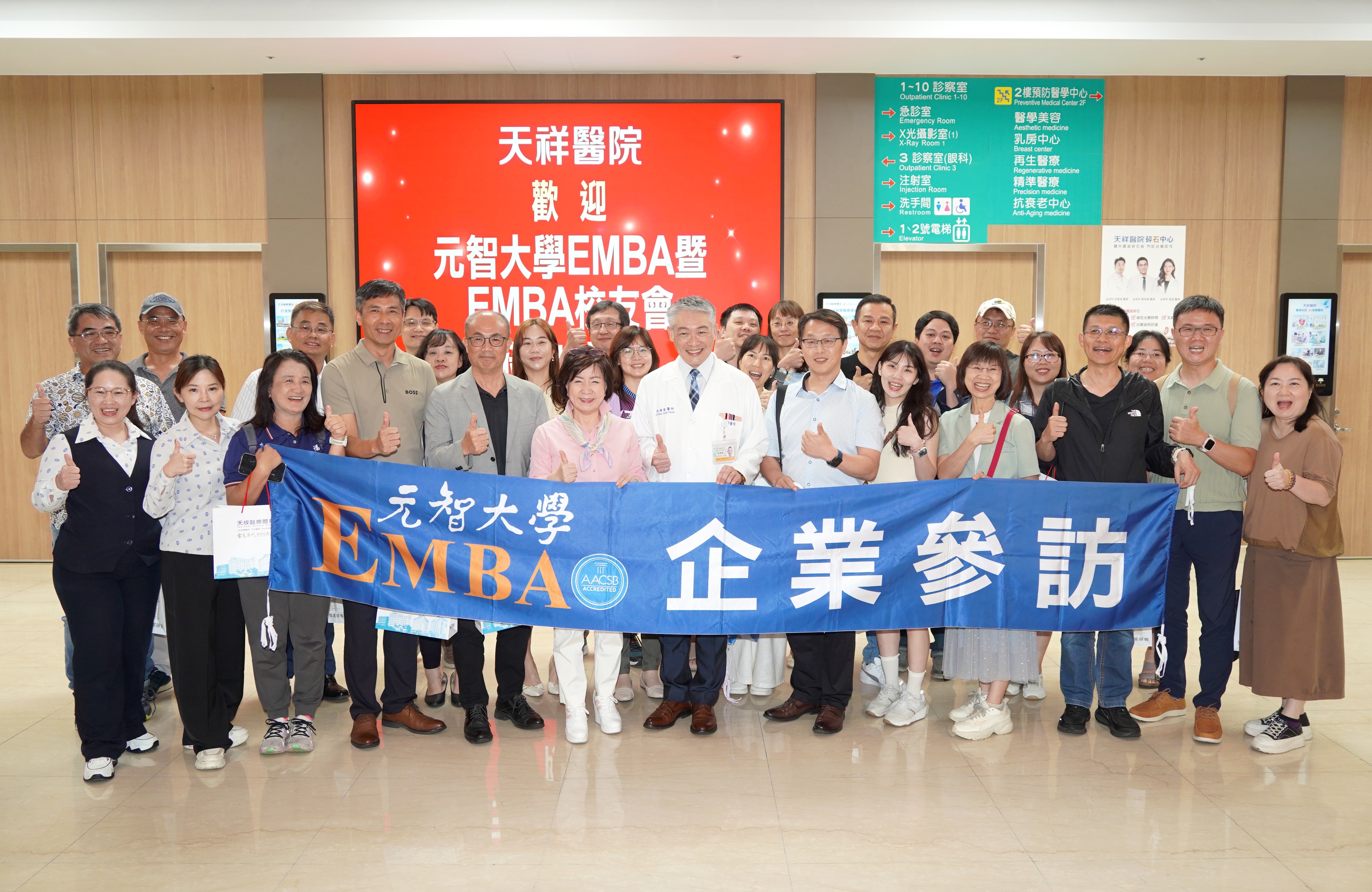
Artificial Intelligence (AI) has been accelerating changes in industrial development, and the medical field has become a key arena for the application of smart technologies. To deepen senior management talents’ understanding of AI trends and digital transformation practices, the EMBA program of Yuan Ze University had organized a year-end corporate visit and invited the Yuan Ze University EMBA Alumni Association to participate.
Led by Executive Director Huai-Chun Lo, nearly 30 faculty members, students, and alumni visited Taoyuan Tianxiang AI Smart Hospital. Through on-site guided tours and in-depth exchanges, participants closely observed the achievements of smart healthcare, intelligent management, and innovative digital technology applications. The visit demonstrated the distinctive features of Yuan Ze University EMBA in emphasizing interdisciplinary integration, industry–academia collaboration, and practice-oriented talent cultivation.
Chairperson Yu-Mei Chang, founder of Tianxiang AI Smart Hospital, had personally received the delegation and shared the hospital’s development vision. As the first newly established general hospital in the Taoyuan area in eight years, Tianxiang AI Smart Hospital had adopted “AI smart healthcare, intelligent management, and smart care” as its core strategies. Smart systems had been comprehensively introduced into outpatient services, emergency care, operating rooms, intensive care units, inpatient wards, long-term care, and telemedicine services, creating a next-generation healthcare environment that integrated technological efficiency with human-centered care.
Yu-Mei Chang had noted that in response to an aging society and rapidly changing healthcare demands, medical services had evolved from treatment-oriented care to comprehensive care. She had therefore proposed the concept of “smart medical and care integration,” aiming to build a warm AI care network “from hospital wards to long-term care.” The hospital had also designed its medical environment based on the three concepts of HOME, HOTEL, and HOSPITAL, redefining the public’s imagination of future healthcare services.
During the event, Vice Superintendent Han-Long Chang had delivered a thematic presentation introducing the practical applications of AI smart healthcare and intelligent management systems and had guided the delegation to visit smart wards and smart care systems. Through firsthand experience, participating faculty members, students, and alumni had gained a deeper understanding of how digital technologies could help healthcare institutions enhance operational efficiency, optimize management processes, and improve service quality and patient experience.
Executive Director Huai-Chun Lo had stated that in the face of the wave of AI and digital transformation, Yuan Ze University EMBA had long been committed to cultivating senior talents with global perspectives, digital thinking, and innovative management capabilities. Through diverse learning approaches such as corporate visits, high-level forums, case studies, and industry–academia collaborations, the program had helped participants grasp industry trends and new management knowledge.
The Yuan Ze University EMBA program had brought together senior executives and business leaders from industries including technology manufacturing, finance and insurance, healthcare, and the service sector, forming an interdisciplinary learning platform and a strong alumni network. Through resource sharing and experience exchange, it had promoted cross-sector collaboration and business connections. This visit not only enabled faculty members, students, and alumni to gain in-depth insights into the practical applications of smart healthcare and digital transformation, but also broadened interdisciplinary perspectives and innovative thinking through exchanges with benchmark enterprises. It fully demonstrated the program’s educational characteristics of integrating theory with practice and aligning learning with industry needs, while continuing to cultivate key leaders capable of driving corporate innovation and transformation.