 EN-US
EN-US  ZH
ZH 
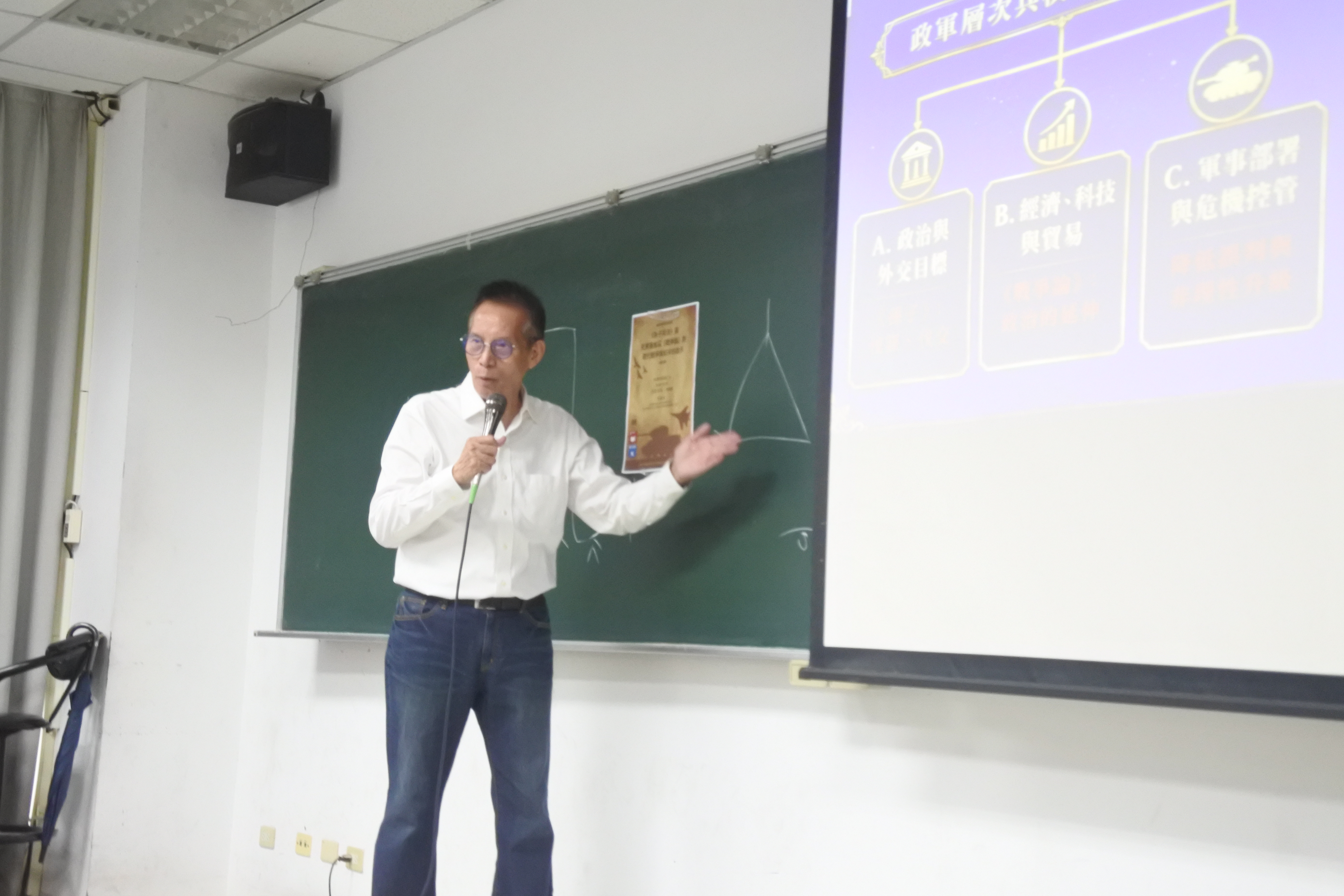
The College of General Studies at Yuan Ze University held a micro-course on June 6, inviting Hua-Chiou Lee, Researcher at the Chinese Association of Strategy and Wargaming, as the keynote speaker. The lecture, titled “Wargaming, Strategic Thinking, and Geopolitics,” integrated years of practical experience and military theory, guiding faculty and students to explore issues such as modern warfare, international situations, and peace strategies.
Hua-Chiou Lee first clarified the distinction between formal wargaming and general scenario simulations. He pointed out that authentic wargaming must include a formal war-gaming table, standardized military symbols, and a complete rules system. It also needed to be closely aligned with current international conditions and strategic environments to effectively support analysis and decision-making.
When discussing Eastern and Western military thought, Hua-Chiou Lee compared concepts such as Laozi’s advocacy of “non-war,” Sun Tzu’s emphasis on “prudence in warfare,” and the German military theorist Carl von Clausewitz’s proposition in On War that “war serves politics.” He noted that modern warfare had already gone beyond simple military conflict, becoming a comprehensive competition involving technology, military power, and economics. Recent events such as the Russia–Ukraine war and conflicts in the Middle East served as important observation cases.
In analyzing the current international situation, Hua-Chiou Lee further applied systems theory to interpret global geopolitical developments and used the framework of “greater and lesser Middle East wars” to explain the complexity of regional conflicts. He pointed out that some national leaders attempted to pursue political interests through unconventional means such as surprise attacks. While such actions reflected realpolitik considerations, they did not necessarily align with the strategic principles emphasized by Clausewitz.
Regarding the factors that determined victory in warfare, Hua-Chiou Lee shared practical insights, noting that among troop strength, firepower, and morale, morale often played a decisive role in shaping outcomes. He also used sports game tactics as an analogy to explain Sun Tzu’s concept of “prudence in warfare,” and extended the strategic notions of “orthodox and unorthodox” to the application of “emptiness and substance.” He emphasized that with technological advancement, metaverse-enabled defense and the integration of virtual and real domains had gradually become important issues in modern governance.
At the end of the course, Feng-Ying Hu from the College of General Studies at Yuan Ze University provided a summary. She approached the topic from the perspective of cross-strait geopolitical risks, pointing out that Taiwan’s key position in the global semiconductor supply chain meant that technological and economic strength had become important leverage for maintaining regional stability and peace. Echoing Sun Tzu’s ideas such as “the supreme art of war is to subdue the enemy without fighting” and the concept of “just warfare,” she emphasized that peace should be regarded as the highest strategic principle, and that all parties should avoid escalating conflicts and expanding the risk of war.
In the final Q&A session, a student asked about the development trends of drone technology and countermeasures. Hua-Chiou Lee responded that although drones had played important roles in several recent conflicts, challenges remained in areas such as training, command, and system integration before they could be fully incorporated into formal military structures. There was still significant room for further development in related applications.
The micro-course concluded successfully through an exchange that integrated both theory and practice. It not only broadened students’ understanding of military studies and international strategy, but also guided participants to reflect on peace, security, and the future development of the international order from a more comprehensive perspective.