
 EN-US
EN-US  ZH
ZH 
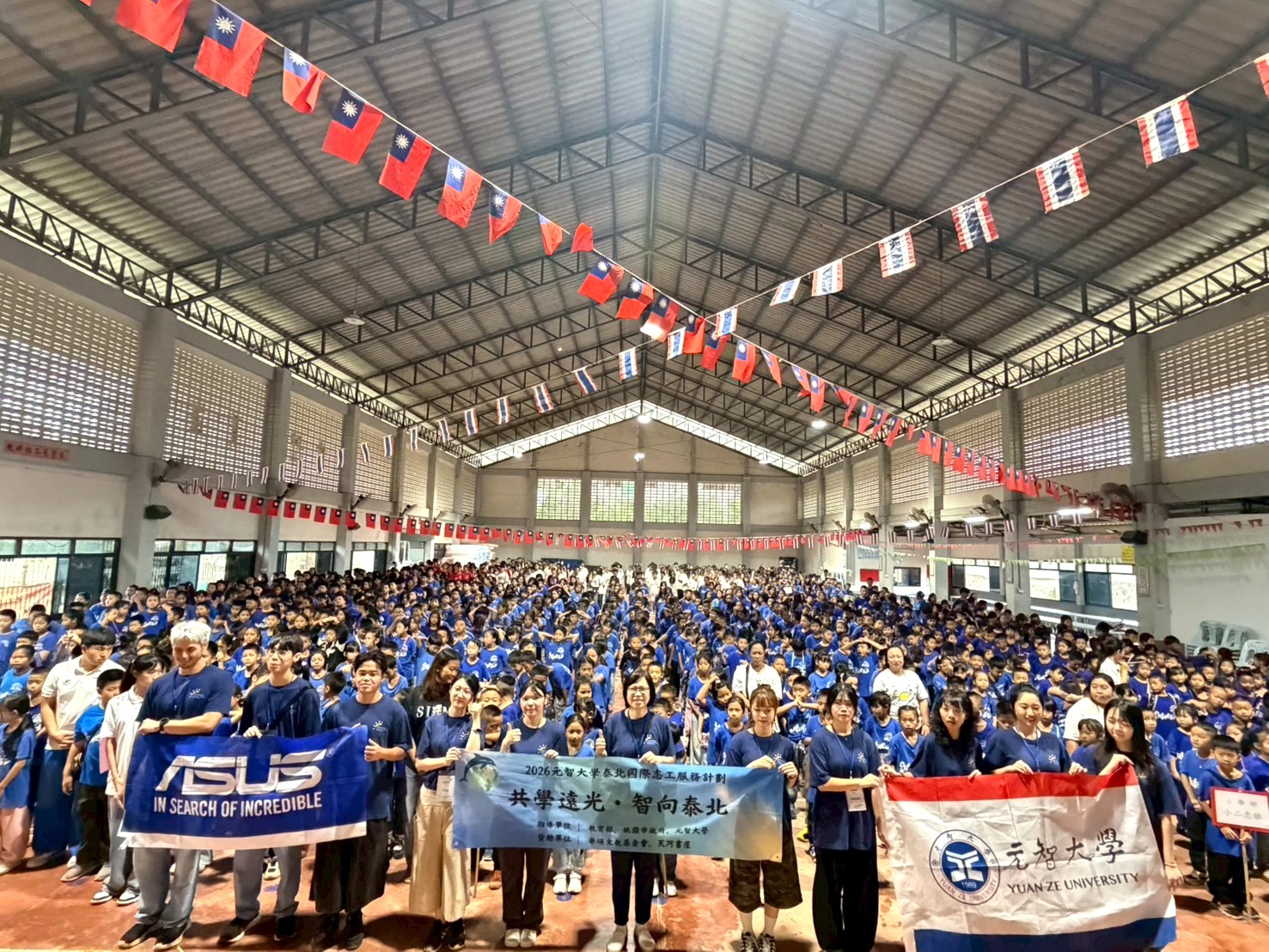
Yuan Ze University’s international volunteer team, together with ASUS volunteers, formed a group of 12 young volunteers who carried out an 18-day educational service program at Doi Tung Maesadadet School in northern Thailand from June 28 to July 15, under the leadership of Hsiu-Chu Lin. For nearly 20 years, Yuan Ze University has continuously devoted itself to educational services in northern Thailand, supporting the growth of children in rural areas through companionship.
This year, the program further integrated diverse courses such as AI technology, creative English, multicultural education, and reading education to help students broaden their horizons, develop digital literacy, and enable young volunteers to practice the spirit of service through cross-cultural exchange. Education thus became an important force that transcended borders and connected people.
This year’s curriculum continued to promote AI technology education. Through Scratch programming, robotic car operation, and interactive hands-on activities, students were guided to learn programming concepts through games and creative projects. These activities fostered logical thinking, problem-solving skills, and digital literacy, laying a solid foundation for engaging with the world of technology in the future. For many students encountering programming for the first time, this was not only a technological experience but also a window into future possibilities.
The highly anticipated English singing courses were held again this year, with volunteers designing age-appropriate teaching materials for different grade levels. Elementary school students sang “Try Everything” with simple movements, cultivating interest in English learning through music. Junior high school students practiced “Monsters” and “Wavin’ Flag,” becoming familiar with lyrics and rhythm through step-by-step instruction. Senior high school students performed “What Makes You Beautiful,” “Baby,” and “Beauty and a Beat,” gradually improving from pronunciation and lyric comprehension to stage performance. Students progressed from initial shyness to confidently performing on stage. The classroom was filled with singing and smiles, demonstrating not only improvements in English ability but also showing how music served as a bridge connecting language, confidence, and dreams.
Li-Chen Kuo, a student from the International Bachelor Program in Strategic Communication, College of Humanities and Social Sciences, Yuan Ze University, and leader of the volunteer team, stated that this year the team had introduced a “Global Cultural Initiative” course. Volunteers from Taiwan, Japan, and Germany shared cultural characteristics from their respective countries and guided students to explore different cultures through interactive activities, encouraging them to bravely explore the world and develop an international perspective. She hoped students would realize that the world was broader than they had imagined and that education was the key to opening this vision.
In addition, for boarding students who were unable to attend local schools due to the lack of Thai citizenship, the volunteer team arranged a “Reading and Academic Support Program of Hope.” By utilizing e-book resources, they created a reading-friendly environment, accompanied students in learning new vocabulary, and guided them in understanding story content, gradually cultivating reading habits. The volunteers also assisted with schoolwork and answered learning questions, helping students build confidence through patient companionship. They believed that each moment of shared reading and each careful explanation could become a small but meaningful step toward changing a child’s future.
Shi-Hsin Li, an eleventh-grade student at the school, shared that she had previously been afraid to speak English or perform singing and dancing. However, with the volunteers’ patient guidance, she gradually built confidence and began to enjoy learning. “I never thought learning English could be so interesting!” she said with a smile, expressing hope to continue participating in similar courses and exploring a broader world. Her transformation from timidity to confidently standing on stage deeply impressed the volunteers, who realized that education brought not only knowledge but also the courage to believe in oneself.
Another student, Mei-Juan Yang, shared her experience taking English and Taiwan society classes taught by the volunteers. She expressed admiration for the volunteers’ dedication and friendliness, noting that they brought practical knowledge different from local teaching. In addition to providing more opportunities to practice language skills, the courses also introduced aspects of life in Taiwan, such as reading train tickets and using transportation. She described the experience as meaningful and enriching.
Mi-Sei Kawai, a second-year Japanese student from the Department of Foreign Languages and Applied Linguistics, Yuan Ze University, stated that participating in the international volunteer service in northern Thailand had allowed her to witness the enthusiasm and eagerness for learning among local students. During the English singing classes, she observed students actively participating and confidently expressing themselves. In addition to teaching English, she was responsible for the “Global Cultural Initiative” course, introducing Japanese culture and daily life. Students showed great interest and actively engaged in discussions, enabling her to appreciate the impact of cultural exchange deeply. She emphasized that teaching and interaction not only brought people closer but also reinforced her belief that education could expand international perspectives and serve as an important bridge connecting different cultures while fostering understanding and friendship.
Advisor Hsiu-Chu Lin stated that Yuan Ze University’s international volunteer team had upheld the spirit of “spreading love across distances and service-learning” for nearly 20 years in northern Thailand. She believed that the greatest value of education lay in accompanying children to discover their own potential. When a child dared to speak English because of encouragement, began to imagine the future through an AI class, or broadened their horizons through cultural exchange, education quietly transformed the trajectory of life.
She further noted that through courses in AI technology, creative English, multicultural education, and reading education, the program not only helped students build confidence and broaden their perspectives but also enabled young participants to learn empathy, respect, and responsibility through cross-cultural experiences. Every sincere moment of companionship planted a seed of hope, and every cross-border encounter became a journey in which one life influenced another. Yuan Ze University would continue to devote itself to educational work in northern Thailand, allowing the power of education to endure, supporting more children in pursuing their dreams and seeing their future, while inspiring more young people to find their purpose in serving society.