 EN-US
EN-US  ZH
ZH 
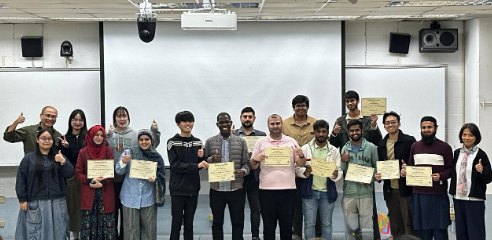
Organized by the International Language and Culture Center (ILCC) of Yuan Ze University in collaboration with the Department of Chinese Linguistics and Literature, the “Mandarin Learning Tutoring Time” program officially launched on November 3 and unexpectedly sparked a wave of enthusiasm across campus. Originally designed as Mandarin tutoring support for international students, the program ultimately attracted 51 participants from 16 countries across four continents.
According to statistics, participants came not only from neighboring Asian countries such as Vietnam, Indonesia, the Philippines, Thailand, Myanmar, Mongolia, India, Pakistan, and Kyrgyzstan, but also from Germany and Spain in Europe; Eswatini, Kenya, and Somaliland in Africa; and even Haiti and Colombia in Central America.
The International Language and Culture Center noted that such diversity unexpectedly created the most natural environment for language learning within the program. As students came from different linguistic backgrounds, Mandarin naturally became the only common bridge for communication and friendship in the classroom. Through interactive activities such as “Mandarin Vocabulary Bingo,” situational skits, and word-chain games, students from diverse cultural backgrounds broke down national boundaries, creating a warm and engaging learning atmosphere.
Unlike traditional for-credit courses, the “Mandarin Learning Tutoring Time” program was positioned as an after-class tutoring and peer-learning initiative. Beyond strengthening international students’ practical Mandarin skills, it also served as a career-oriented practicum closely integrated with the Department of Chinese Linguistics and Literature. A team of 11 enthusiastic student teaching assistants (TAs)—eight of whom were from the department—took on the role of “junior instructors.” Through the program, department students translated pedagogical theories learned in class into hands-on teaching practice, accumulating valuable experience for future careers in Mandarin language education.
Hui-Shu Hung, Chair of the Department of Chinese Linguistics and Literature, expressed strong affirmation of this collaborative model. She emphasized that Mandarin teaching should not be confined to classroom theory alone, and that the jointly promoted “Learning Tutoring Time” represented an ideal example of learning by doing. By directly engaging with international students from diverse cultural backgrounds, department students were able to transform textbook knowledge into concrete teaching experience, effectively enhancing their instructional skills while cultivating the cross-cultural communication and adaptability essential for future careers in Mandarin education.
It was also noteworthy that the TA team itself was highly international, including students from Vietnam and South Korea. Drawing on their own experiences as Mandarin learners, these international senior students guided newer learners in overcoming language barriers. With a deep understanding of the challenges faced by international learners, they designed teaching materials that better aligned with students’ perspectives, demonstrating the appeal of Mandarin as a shared campus language. To encourage beginners and elementary-level learners to speak up, the TA team moved away from rigid textbook-based instruction and instead focused on daily-life applications and situational dialogues. Course content covered pronunciation, grammar, Chinese characters, and everyday conversations, complemented by interactive activities such as vocabulary bingo, role-playing skits, and Mandarin song sessions, allowing students to acquire language skills naturally in a relaxed environment.
Tzu-Chun Lin, a second-year master’s student from the Department of Chinese Linguistics and Literature who served as a Mandarin tutor, shared, “Standing on the podium as a teacher for the first time was naturally nerve-racking, but the students’ enthusiasm and dedication quickly eased my anxiety. This experience of mutual learning not only helped me realize the value of teaching, but also built my confidence.” Wen-Jie, a beginner-level Mandarin learner from India, said, “The course was very practical. Being able to apply what I learned directly to daily situations made living in Taiwan much more comfortable.” In addition, two advanced Mandarin learners—Elisa Yeh from Germany and Semin Sae from Colombia—agreed that, beyond interest, the key to language learning was having the courage to speak, as only then could a language truly be internalized as part of daily life.
Hsin-Hung Chen, Director of the International Language and Culture Center, pointed out that while the government had actively promoted employment opportunities for international students in Taiwan in recent years, his observations from a background in human resources and research on graduate employability revealed that although international students often possessed strong professional skills, Mandarin communication ability was frequently the decisive factor in successfully entering the Taiwanese job market and sustaining long-term career development. He emphasized, “The Mandarin Learning Tutoring Time was not just about learning a language—it was an accelerator for cultural adaptation. Through this natural, highly interactive learning environment, we hoped to reduce students’ resistance to Mandarin, enhance their daily adaptability, and ultimately strengthen their future employability.”
The program reached its climax on December 10 with a final presentation and sharing session. Participants took turns confidently showcasing the results presentation of six weeks of intensive practice. Performances ranged from basic self-introductions in Mandarin to classical poetry recitations and renditions of popular Mandarin songs. Fu-Mei Hsu, a faculty member from the Department of Chinese Linguistics and Literature who had long been dedicated to promoting Mandarin education, attended the event to offer encouragement. She expressed admiration for the impressive language progress demonstrated by international students in such a short period and expressed hope that future collaboration between the department and the International Language and Culture Center would further deepen, jointly creating a more comprehensive and high-quality Mandarin learning environment. The six-week learning journey concluded with a warm cross-cultural dinner gathering, bringing the “Mandarin Learning Tutoring Time” program to a perfect close.