 EN-US
EN-US  ZH
ZH 
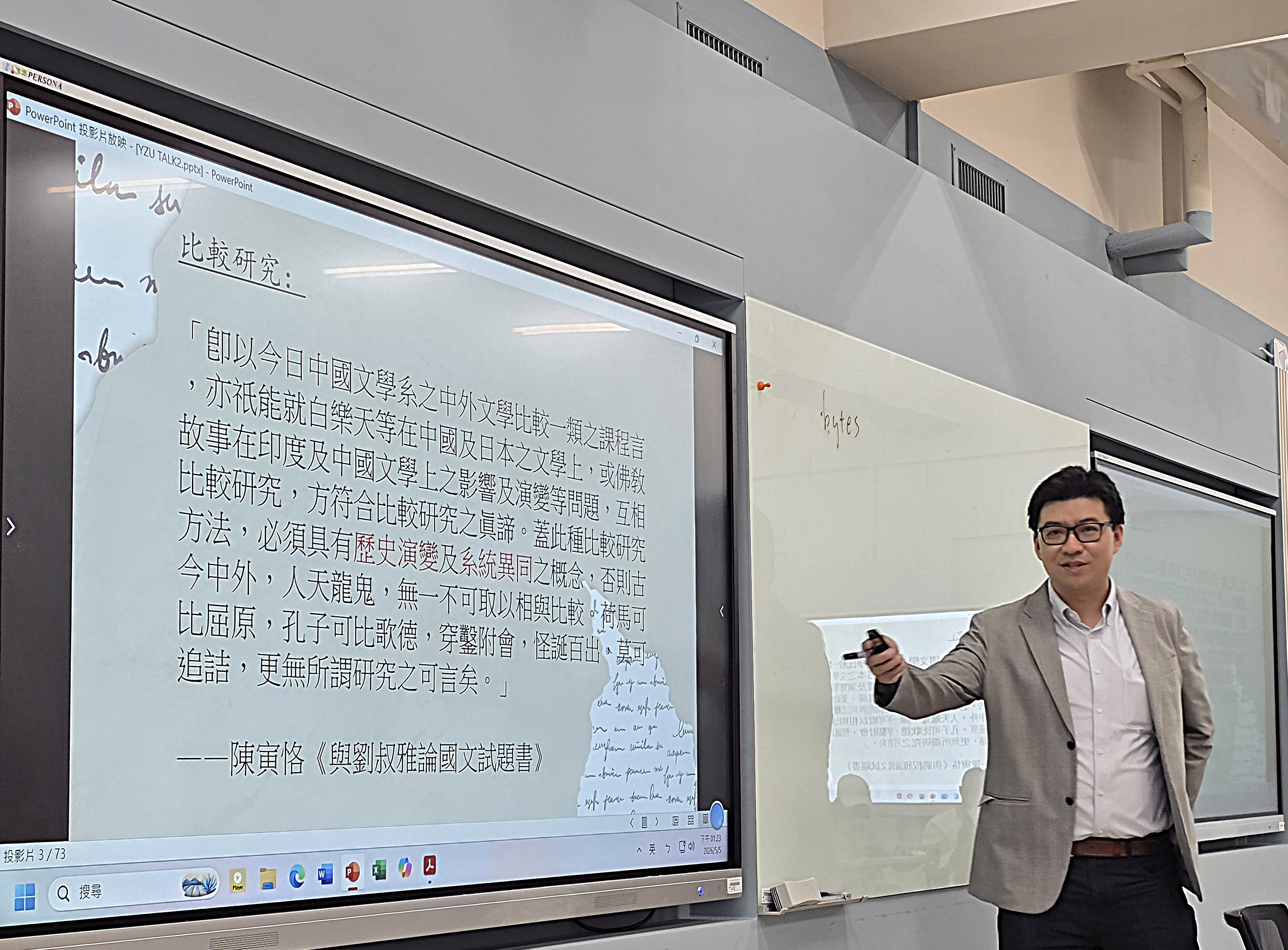
Professor Liheng Xu from the Department of Chinese and History at City University of Hong Kong was invited to visit the Department of Chinese Linguistics and Literature at Yuan Ze University, where he delivered two keynote lectures focusing on the latest developments in digital humanities, artificial intelligence (AI), and Chinese historical and cultural studies.
The lectures attracted enthusiastic participation from faculty members and students. Through case studies integrating historical research and AI technologies, he guided the audience to rethink the value and future direction of the humanities in the age of AI.
Liheng Xu received his Ph.D. from the University of Oxford and had previously worked at the China Biographical Database (CBDB) research center at Harvard University. He had long been engaged in research on Chinese history, Song dynasty history, and digital humanities, and was a renowned international scholar in these fields. He had also been elected as a Fellow of the Royal Historical Society and the Royal Asiatic Society of Great Britain and Ireland, and had received the University Grants Committee (UGC) Teaching Award from the University of Hong Kong.
The two lectures were titled “Reflections on Four Approaches to Digital Humanities Research: A Discussion Based on Chinese History” and “Brush, Ink, and Bytes: Digital Organization and Analysis of Surviving Letters and Model Calligraphy of the Song Dynasty.” Through examples such as historical biographical databases, geographic information systems (GIS), text analysis, and social network research, Professor Xu explained how digital technologies had transformed traditional approaches and perspectives in historical and literary studies.
During the lectures, Professor Xu also shared his extensive experience in digitalizing historical documents, text annotation, and AI-assisted research. Using the study of Song dynasty letters and model calligraphy as examples, he demonstrated how digital tools had been used to reconstruct communication networks and knowledge dissemination among ancient literati. He further compared Chinese and Western medieval epistolary cultures, presenting achievements in cross-cultural studies and the integration of digital humanities.
In response to the rapid rise of generative AI, Professor Xu pointed out that although technological tools could greatly enhance research efficiency, the depth and academic value of research still depended on the researcher’s critical thinking and ability to formulate meaningful questions. He believed that the humanities would not be replaced in the AI era; instead, there would be an even greater need for interdisciplinary integration and deep analytical thinking. His perspectives sparked lively discussions among faculty members and students, and helped students gain a deeper understanding of the value of the humanities in the AI era.
The Department of Chinese Linguistics and Literature stated that this exchange not only deepened faculty members’ and students’ understanding of digital humanities and AI applications but also further promoted international academic collaboration between City University of Hong Kong and Yuan Ze University. Both sides had discussed future cooperation in organizing academic lectures, conducting joint research, developing digital humanities courses, and promoting inter-university exchanges, laying a solid foundation for continued collaboration.
The department also noted that as generative AI continued to rapidly reshape the world, Chinese departments could no longer remain confined to traditional literary studies, but must actively integrate technology and interdisciplinary competencies. With more than a decade of experience in digital teaching, The department has in recent years actively promoted AI, humanities technology, and interdisciplinary courses, striving to cultivate a new generation of talent equipped with humanistic literacy, global vision, and technological application skills.
The university emphasized that through in-depth exchanges with internationally renowned scholars, students were able to gain access to the latest research methods in AI and digital humanities, while also learning how to integrate literature, history, culture, and technology. This approach aimed to cultivate essential skills such as language expression, interdisciplinary thinking, and critical analysis, thereby creating new possibilities for humanities education.